Residential electrical service - Chandler, Arizona
Outdoor Lighting Chandler AZ: Security Lighting Built on City and Police Guidance (2026 Guide)
How to light doors, walks, driveways and patios the way Chandler Police and the City's homeowner manual describe, and how to control, wire and permit it.
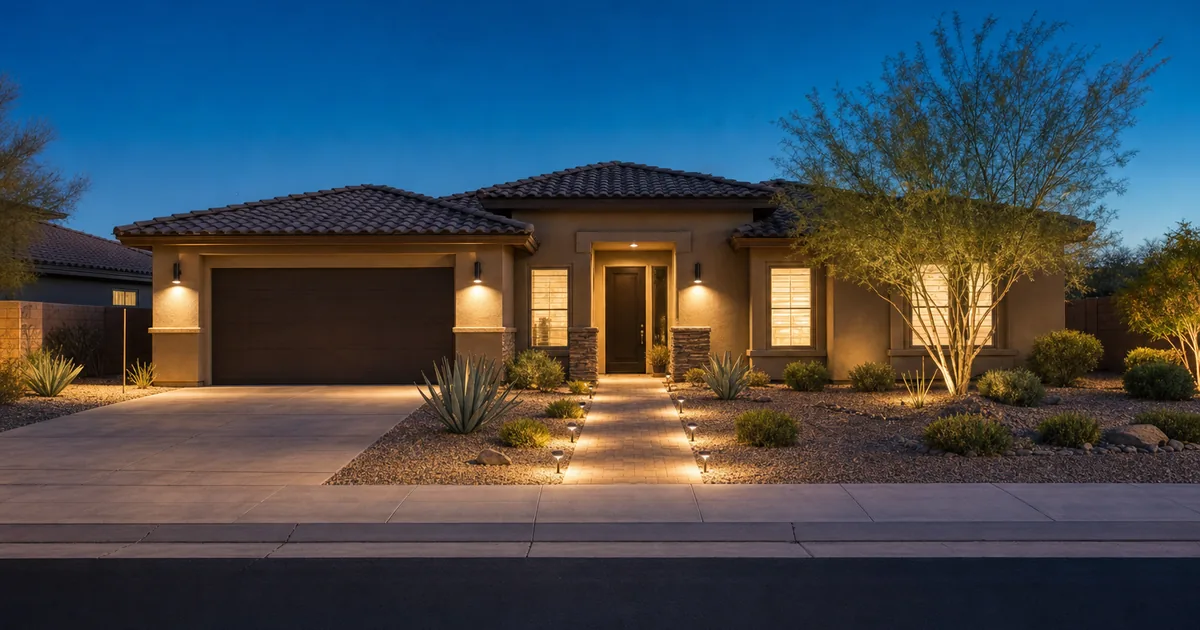
Quick answer
Good outdoor and security lighting for a Chandler home is even, shielded light at every door, walk and driveway, switched on every night by a photocell or timer. Chandler Police guidance says brighter is not automatically better, because glare creates blind spots, and their home assessment asks for at least 50 feet of visibility at entries. The City's homeowner manual requires a switched exterior light at each egress door and GFCI protection on readily accessible outlets. Whether a specific job needs a permit is a question for Chandler Permits.
Outdoor lighting Chandler homeowners ask about usually falls into two jobs: lights that make a home easier and safer to use after dark, and security lighting meant to remove hiding places around doors, driveways and side yards. This page builds both on Chandler's own documents: the Chandler Police Department's crime prevention (CPTED) handbook and home assessment form, and the City of Chandler's Home Owners Building Permit Manual.
It covers what the police recommend, what the City's basics require at doors and outdoor outlets, how bright the lights should be, how to control them, where LED and solar fit, the permit question and who installs the wiring. It is written for single-family homes inside Chandler city limits and does not invent ordinances the City has not adopted.
Key takeaways
- The Chandler Police CPTED Handbook says lighting by itself does not prevent crime but does provide a sense of safety, and it favors uniform, shielded light over the brightest fixture.
- The Chandler Police Residential CPTED Assessment asks whether entryways, sidewalks and driveways are lit with at least 50 feet of visibility and lit every night by a timer or photocell.
- The City of Chandler's homeowner permit manual requires a switched exterior light at the exterior side of each egress door, with weatherproof switches on the outside of the building.
- The same City manual requires GFCI protection on all readily accessible outlets and an outdoor receptacle at the front and back of a home with direct access to grade.
- The U.S. Department of Energy says a motion sensor combined with a photosensor may suit security lights that are needed only when it is dark and someone is present.
- No Chandler document we read says whether replacing or adding an outdoor light fixture needs a permit, so ask Chandler Permits at 480-782-3074 before the work starts.
What does outdoor and security lighting work include for a Chandler home?
Outdoor lighting on a house is several small systems that share the same weather, the same circuits and the same switches. The jobs homeowners ask about fall into a handful of groups:
- Entry lighting. Porch and door fixtures at the front door, the back door and any door from the garage to the yard.
- Garage and driveway lighting. Wall fixtures beside the garage door and floodlights that cover the driveway and the approach to the house.
- Security lighting. Motion-sensor lights for side yards, gates and the back of the lot, the places nobody sees from the street.
- Patio lighting. Ceiling fixtures under a covered patio, wall lights on the back of the house and lights at a ramada or pergola.
- Address lighting. A lit house number that visitors and emergency crews can read from the street.
- Controls and outlets. Photocells, timers, motion sensors, weatherproof switches and the outdoor receptacles that often share a circuit with the lights.
Low-voltage path and garden lights are a separate design question and are covered on landscape lighting in Chandler; indoor fixtures are on lighting installation in Chandler. This page stays with line-voltage fixtures mounted on or near the house and the controls that run them, because that is where security guidance, the City's code basics and the permit question meet.
Two things make outdoor work different from indoor work. Every fixture, box and switch lives in sun, dust and monsoon rain, so the parts have to be rated for the location and sealed to the stucco. And outdoor fixtures often sit on circuits that also feed outdoor outlets, which the City's homeowner manual says need GFCI protection when they are readily accessible. A lighting job that ignores the rest of the circuit can leave a problem behind even when the new fixture works perfectly.
What do Chandler Police recommend for home security lighting?
The Chandler Police Department treats lighting as part of Crime Prevention Through Environmental Design, usually shortened to CPTED. The department's crime prevention page calls effective lighting "an example of natural surveillance": light lets neighbors, passers-by and the people inside see what is happening around the house. Its 2025 CPTED Handbook is careful about what light can and cannot do, saying that lighting by itself does not prevent crime but does provide a sense of safety. This page makes no crime-reduction claim either; no Chandler figure we read links lighting to fewer burglaries.
What the handbook does give is direction on how to light. It asks for uniform and consistent illumination so there are no pockets of shadow or glare where an adult could hide; dusk-to-dawn operation using timers or dawn-to-dusk sensors; and fixtures that are vandal and tamper resistant, fastened with tamper-resistant screws. It also asks that lights be kept free of obstructions so the light stays even, and that landscaping be trimmed so it neither blocks fixtures nor creates hiding spots.
For a single home, the department's Residential CPTED Assessment form turns those ideas into questions. It asks whether all exterior doors are well lit; whether entryways, sidewalks and driveways are lit with at least 50 feet of visibility; whether those areas are lit every night by a timer or photocell; and whether address numbers are four to six inches tall, lit and visible from the street. Chandler Police say a specialist in their Crime Prevention Unit will assess a home at no cost and make recommendations covering doors, windows, locks, lights and landscaping. Requests go through the department's non-emergency line at (480) 782-4130.
When we walk a Chandler property before quoting security lighting, we usually look at the side yards and the back wall first, because they are the areas a homeowner rarely sees after dark and the ones the assessment questions point toward. A police assessment and an electrician's walk-through work well together: the officer says where light is needed, and the electrician works out how to get power there safely and which circuit can carry it.
What should a security lighting checklist for a Chandler home include?
The chart below puts the Chandler Police assessment questions, the handbook's guidance and the City's homeowner manual on one page, alongside what we look for on site. It is a checklist, not a code: the police items are recommendations, while the door light and the GFCI outlets come from the City's permit manual.
| Check | What the source says | Source | What we check on site (our reading) |
|---|---|---|---|
| 1. Every exterior door lit | Asks whether all exterior doors are well lit; a switched exterior light is required at the exterior side of each egress door | Chandler Police Residential CPTED Assessment; City Home Owners Building Permit Manual | A switched fixture at every door to the outside, with weatherproof switches where they are outdoors |
| 2. Entries, walks, driveway | Lit with at least 50 feet of visibility | Chandler Police Residential CPTED Assessment | Even light from the street to the front door, without a dark gap at the walk |
| 3. On every night | Lit every night by a timer or photocell; dusk-to-dawn by timers or sensors; photosensor plus motion sensor can suit security lights | Chandler Police assessment and CPTED Handbook; U.S. Department of Energy | Photocell control at entries and driveway; motion control at side yards and gates |
| 4. Even, shielded, no glare | Uniform, consistent light; glare causes temporary blindness; directed and shielded lighting | Chandler Police CPTED Handbook | Shielded fixtures aimed down; several moderate fixtures instead of one bare flood |
| 5. Address numbers lit | At least four to six inches tall, lit and visible from the street | Chandler Police Residential CPTED Assessment | A lit house number on the same photocell control as the entry lights |
| 6. Plants trimmed | Shrubs at 2 feet or less; tree canopies at 6 feet or higher; lights kept free of obstruction | Chandler Police CPTED Handbook | Fixture positions that stay clear as landscaping grows |
| 7. Tamper-resistant fixtures | Vandal and tamper resistant fixtures; tamper-resistant screws | Chandler Police CPTED Handbook | Secure fasteners on any fixture within reach of the ground |
| 8. Outdoor outlets, GFCI | Receptacle at front and back; GFCI on readily accessible outlets; test GFCIs at least monthly | City Home Owners Building Permit Manual; Consumer Product Safety Commission | Every GFCI that protects outdoor outlets on the lighting circuits trips on test and resets |
How we got this table. The middle columns summarize the Chandler Police CPTED Handbook (2025) and Residential CPTED Assessment form, the City of Chandler Home Owners Building Permit Manual (Rev. 4/09/26), the U.S. Department of Energy lighting-controls page and the Consumer Product Safety Commission GFCI fact sheet, read November 27, 2026. The right-hand column is our own reading of how each item shows up on a home; it is trade practice, not measured data, and not a ruling by the City or the police. Only the door light and the GFCI outlets come from the City's permit manual; the rest are police recommendations.
Two items on the list are about plants, not wiring. The handbook suggests trimming dense shrubs to 2 feet or less and tree canopies to 6 feet or higher. In a desert yard that matters for lights as much as for sight lines: a tree or shrub that grows across a floodlight turns an even pool of light into a patch of glare with a deep shadow behind it.
How bright should outdoor security lights be around a Chandler home?
Not as bright as possible. The Chandler Police handbook makes the point that brighter is not automatically better and that good lighting is "intentional and not random". It warns that glare makes it hard to see and that overly bright lights shock the eye and cause a temporary blindness, which is why it stresses directed and shielded lighting.
In practice, a person standing in the beam of a glaring floodlight can see little beyond it, while someone in the shadow just outside the beam is hard to spot. Several moderate fixtures spread along a wall usually give the even coverage the handbook describes better than one powerful lamp. Shielded fixtures that point light down at the ground also keep it out of windows, including the neighbor's. On Chandler security lighting calls we often find a single high-output floodlight aimed across the driveway; replacing it with shielded fixtures at the garage and along the walk generally leaves the yard more usable and less glaring.
The handbook does include an expected foot-candle table: 4 to 5 foot-candles for high-risk areas, 3 to 4 for medium-high risk areas such as parking, and 1 to 2.5 for multifamily entrances and community walkways. Those figures are written for communities and multifamily sites, and the handbook tells readers to consult a Crime Prevention Officer about which apply. No Chandler document we read sets a foot-candle level for a single-family home.
What about light spilling onto a neighbor's lot? The City's design standards, in a September 2025 amendments document marked draft, require external lighting on developments to keep light from being directed off the property, but they exempt single-family homes built on an individual basis. Arizona statute A.R.S. 49-1102 says outdoor light fixtures are to be fully or partially shielded, with exceptions for some lower-wattage sources; we did not confirm how that statute is applied inside Chandler. Homeowner associations may have their own lighting rules, so read your HOA documents before choosing fixtures. Shielded, downward light meets the police guidance whichever rules apply to your lot.
What does the City of Chandler require for exterior lights and outdoor outlets?
Chandler builds to the 2024 International Codes with the 2023 National Electrical Code, as amended by the City, for plans submitted on or after July 1, 2025. The City's local electrical amendments are narrow GFCI and receptacle items, such as an exception for receptacles that are not readily accessible and one for listed heating and cooling equipment. None of the amendments we read deal with luminaires or exterior lighting, so the national code applies to outdoor fixtures as written.
The City's Home Owners Building Permit Manual adds plain-language basics that shape outdoor lighting work:
- "A switched exterior light is required at the exterior side of each egress door."
- Switches located on the exterior of a building must be weatherproof.
- A light must be provided inside the garage, with its switch at the interior door.
- All readily accessible outlets need ground-fault circuit interrupter (GFCI) protection.
- A home with direct access to grade needs an outdoor receptacle at the front and the back, reachable while standing at grade, and a balcony, deck or porch needs at least one receptacle within its perimeter.
- Metal patio covers within 5 feet of a swimming pool must be tied into the pool's equipotential bonding.
- A coop connected to electricity or water needs a building permit regardless of its size, so a lit coop is a permit question.
GFCI protection matters outside because water and dust reach places they never reach indoors. A GFCI trips on ground-fault current, meaning current leaking to ground, which is often caused by moisture. The U.S. Consumer Product Safety Commission says a GFCI trips at a difference as little as 0.006 amperes, notes that outdoor receptacles have been GFCI-protected since 1973 under the national code, and recommends testing at least once a month. Outlet work is covered in more detail on outlet installation and repair in Chandler, and patio covers and lights near a pool on hot tub and pool wiring in Chandler.
Does adding or replacing outdoor lights in Chandler need a permit?
No City of Chandler document we read answers that question directly for outdoor fixtures, so this page does not answer it for you. The City's amendments exempt some like-for-like repair or replacement of motors, transformers and overcurrent devices, but that wording does not mention light fixtures and does not cover a new circuit. Before the work starts, ask the City: Chandler Permits at 480-782-3074, or the Plan Reviewer of the Day at 480-782-3078.
If a permit is needed, Chandler handles it through Development Services at 215 E. Buffalo St., open Monday through Friday from 8 a.m. to 5 p.m. Fees are paid through the City's Citizen Access Portal, and permit status and inspections are followed at developmentpermits.chandleraz.gov/clics. Inspections are requested on the inspection line at 480-782-3100, and a call before midnight is for the next day. The homeowner manual sets a minimum permit fee, warns that work done without a permit may be charged double fees, says permitted work is done by a licensed contractor unless the owner-applicant performs it personally, and says a licensed contractor must pull the permit on a rented or leased home.
The electric utility rarely changes an outdoor lighting job. The City lists both SRP and APS as electric providers in Chandler, and new fixtures and circuits on the house side of the meter are a matter for the contractor and the City. The utility becomes part of the job only if the work touches the service or meter, for example when lighting is combined with a larger upgrade. The name on your electric bill, or SRP's address lookup tool, tells you which utility serves your home; more is on SRP and APS in Chandler explained. Our research found no SRP or APS rebate for outdoor lighting, so none is described here.
Should outdoor security lights use motion sensors, photocells or timers?
Each control answers a different need. A photocell, which the Department of Energy calls a photosensor, senses ambient light and switches lights on at dusk and off at dawn; DOE says that makes photosensors useful for all types of outdoor lighting. A timer runs lights on a schedule, and a motion sensor turns a light on only when something moves within its range.
The Chandler Police guidance leans toward steady light where people come and go: the handbook calls for dusk-to-dawn operation using timers or sensors, and the assessment asks whether entries, walks and driveways are lit every night by a timer or photocell. For security lights needed only when it is dark and someone is present, DOE says the right control might be a combination of a motion sensor and a photosensor. A common arrangement is steady, moderate photocell lighting at the front entry, walk, driveway and address number, with motion-activated lights at side yards, gates and the back of the lot where constant light is not needed.
We often find photocells that misbehave because of where they sit. A sensor under a deep patio cover or in the shadow of a wall can read dusk too early, and one that sees its own fixture's light can cycle on and off through the night. Placing the sensor where it sees open sky, and away from the lamp it controls, fixes most of that without new equipment. Motion sensors have the opposite problem: aimed at a street or a swaying shrub, they trigger constantly and stop meaning anything.
Are LED and solar outdoor lights a good fit for a Chandler home?
LED is now the usual choice for outdoor fixtures. The Department of Energy says LEDs use at least 75% less energy and last up to 25 times longer than incandescent lighting, and that they are increasingly used for walkway and other outdoor area lighting. For a light that runs from dusk to dawn every night, the longer life also means fewer ladder trips to high eaves. Many outdoor LED fixtures are integrated units, so check whether the light source can be replaced or the whole fixture has to be changed when it fails.
Solar lights need no wiring, which suits paths and spots far from a circuit, but DOE lists trade-offs. Solar lights use solar cells that convert sunlight into electricity, so a panel shaded by trees, walls or a patio cover charges poorly. DOE says operating times in the winter months may vary by as much as 30% to 50%, and it advises checking with the manufacturer whether replacement bulbs or batteries are available. For the steady entry and driveway lighting the police assessment asks about, a hard-wired fixture on a photocell is the more dependable option; solar fits accent and low-priority spots.
Whatever the light source, choose fixtures rated for wet locations where rain can reach them, and seal the mounting box to the stucco so monsoon water does not track into the wall. If an existing fixture flickers, buzzes or trips a breaker, treat it as a repair first; electrical repair in Chandler covers that troubleshooting.
What are the most common mistakes with outdoor lighting in Chandler?
- One very bright floodlight instead of even coverage. The Chandler Police handbook warns that glare causes temporary blindness and leaves shadows to hide in.
- Unshielded fixtures aimed outward. Light thrown into the street or a neighbor's windows is glare, not security; aim it down at the ground you want to see.
- Lights that depend on someone remembering a switch. The police assessment asks for entries and driveways lit every night by a timer or photocell.
- Assuming a fixture swap or new circuit needs no permit. No City document we read settles it for outdoor lights; ask Chandler Permits at 480-782-3074 first.
- Outdoor outlets without working GFCI protection. The City requires GFCI on readily accessible outlets, and the CPSC recommends testing them at least once a month.
- Letting plants swallow the lights. The handbook suggests shrubs at 2 feet or less and tree canopies at 6 feet or higher.
Who installs outdoor and security lighting in Chandler?
Outdoor lighting on the house is line-voltage electrical work: new circuits, boxes set in stucco, weatherproof switches, photocells and GFCI-protected outlets. Chandler's homeowner manual says permitted work is done by a licensed contractor unless the owner-applicant does it personally. Before hiring, ask for the contractor's Arizona license number and classification, whether they have asked the City if your job needs a permit, and which circuit the new lights will use.
Outdoor and security lighting requested through Your Chandler Electrician is performed by Alvey Electric LLC, Arizona Registrar of Contractors license ROC 364723 (R-11, residential). The work is residential only. If you want a security review from the police side, the Chandler Police Crime Prevention Unit's home assessment can come first, and the wiring can follow its recommendations.
Frequently asked questions
Do Chandler Police offer a home security lighting assessment?
Yes. Chandler Police say a specialist in their Crime Prevention Unit will assess a home at no cost and make recommendations covering doors, windows, locks, lights and landscaping. The department's assessment form asks whether exterior doors are well lit, whether entries, walks and driveways have at least 50 feet of visibility, and whether lights come on every night by timer or photocell. Requests go through the non-emergency line at (480) 782-4130.
How bright should outdoor security lights be around a Chandler home?
Bright enough to light the area evenly, not as bright as possible. The Chandler Police CPTED Handbook says brighter is not always better, warns that glare causes temporary blindness, and asks for uniform, shielded lighting without pockets of shadow. The handbook's foot-candle table is written for communities and multifamily sites, and no Chandler document we read sets a level for a single-family home. Several moderate shielded fixtures usually work better than one floodlight.
Does adding or replacing outdoor lights in Chandler need a permit?
No City of Chandler document we read answers that directly for outdoor fixtures. The City's amendments exempt some like-for-like replacement of motors, transformers and overcurrent devices, but that wording does not mention light fixtures or new circuits. Ask Chandler Permits at 480-782-3074 or the Plan Reviewer of the Day at 480-782-3078 before the work starts.
How much does outdoor lighting installation cost in Chandler?
This page does not quote a price because no public source sets one. The cost depends on whether wiring already reaches the spot or a new circuit has to be run through the attic and stucco, how many fixtures and what type, the controls chosen, any GFCI or outlet corrections found on the circuit, the mounting height, and whether a permit is needed; the City's manual sets a minimum permit fee. A written estimate after a site visit is the reliable number.
Is a light required at every exterior door in Chandler?
Yes. The City of Chandler's Home Owners Building Permit Manual says a switched exterior light is required at the exterior side of each egress door, and switches on the outside of a building must be weatherproof. The manual also requires a light inside the garage with its switch at the interior door. The Chandler Police assessment separately asks whether all exterior doors are well lit.
Should I use motion sensor lights or dusk-to-dawn lights?
Usually both, in different places. The Chandler Police handbook calls for dusk-to-dawn lighting using timers or sensors, and its assessment asks for entries and driveways lit every night. The Department of Energy says a combination of a motion sensor and a photosensor may suit security lights needed only when it is dark and someone is present. Steady photocell light fits entries and driveways; motion lights fit side yards and gates.
Do outdoor outlets in Chandler need GFCI protection?
Yes. The City's homeowner manual says all readily accessible outlets need GFCI protection and requires an outdoor receptacle at the front and back of a home with direct access to grade. A GFCI trips on ground-fault current, often caused by moisture. The Consumer Product Safety Commission says a GFCI trips at as little as 0.006 amperes and recommends testing it at least once a month.
Are solar outdoor lights a good idea in Chandler?
They fit accent and low-priority spots far from a circuit. The Department of Energy says solar lights charge from solar cells, so shade from trees, walls or a patio cover weakens them, and winter operating times may vary by as much as 30% to 50%. DOE also advises checking whether replacement bulbs or batteries are available. For entries and driveways that should be lit every night, a hard-wired fixture on a photocell is more dependable.
SRP or APS - does it matter for an outdoor lighting job?
Rarely. Chandler homes get electricity from SRP or APS depending on the address, but new fixtures and circuits on the house side of the meter are handled by the contractor and the City. The utility only becomes involved if the work touches the meter or service. Check the name on your electric bill or SRP's address lookup tool to see which serves your home. We found no SRP or APS outdoor-lighting rebate.
Is there a Chandler rule about outdoor light shining on my neighbor's house?
Not one we found for individual homes. The City's design standards, in a September 2025 document marked draft, keep development lighting from being directed off the property but exempt single-family homes built on an individual basis. Arizona statute A.R.S. 49-1102 calls for outdoor fixtures to be fully or partially shielded, with exceptions; we did not confirm how it applies in Chandler. Check your HOA rules, and use shielded fixtures aimed down.
How tall should house numbers be, and should they be lit?
The Chandler Police Residential CPTED Assessment asks whether address numbers are at least four to six inches tall, illuminated and visible from the street. Putting the number light on the same photocell control as the entry lights keeps it lit every night without anyone remembering a switch, so visitors and emergency crews can find the house after dark.
Who installs outdoor lighting requested through Your Chandler Electrician?
Outdoor and security lighting requested through Your Chandler Electrician is performed by Alvey Electric LLC, Arizona Registrar of Contractors license ROC 364723 (R-11, residential). The work is residential only. Before any job, ask Chandler Permits at 480-782-3074 whether it needs a permit; the City's homeowner manual says permitted work is done by a licensed contractor unless the owner-applicant performs it personally.
The short version
Start from where light is needed, not from the fixture aisle: every door, the walk, the driveway and the address number lit evenly every night, with motion lights only where steady light is not needed. Choose shielded fixtures aimed down, keep plants clear of them and keep the outdoor GFCIs tested. Before any new circuit or fixture change, ask Chandler Permits whether the job needs a permit, then have a licensed contractor wire it.
This page is general information about residential electrical work in Chandler, Arizona. It is not engineering, legal or code advice for a specific property. Permit rules, utility requirements and adopted codes change; confirm current requirements with the City of Chandler and your electric utility before work begins.
References
- Chandler Police Department, CPTED Handbook (2025): lighting guidance, glare, tamper-resistant fixtures, landscaping heights, foot-candle table. https://chandlerazpd.gov/wp-content/uploads/2025/07/CPTED-Handbook-2025.pdf. Read November 27, 2026.
- Chandler Police Department, Residential CPTED Assessment form (exterior doors, 50 ft visibility, timer or photocell, address numbers). https://chandlerazpd.gov/wp-content/uploads/2025/07/Residential-CPTED-Assessment-5-22-18.pdf. Read November 27, 2026.
- Chandler Police Department, Crime Prevention Through Environmental Design (CPTED) and assessments. https://chandlerazpd.gov/crime-prevention-through-environmental-design-cpted-and-assessments/. Read November 27, 2026.
- City of Chandler, Home Owners Building Permit Manual (Rev. 4/09/26). https://www.chandleraz.gov/sites/default/files/departments/development-services/City-of-Chandler-Home-Owners-Building-Permit-Manual.pdf. Read November 27, 2026.
- City of Chandler, Amendments to the 2024 International Codes (Ordinance No. 5108, local NEC and IRC amendments). https://www.chandleraz.gov/sites/default/files/departments/development-services/City-of-Chandler-Amendments-to-the-2024-International-Codes.pdf. Read November 27, 2026.
- City of Chandler Development Services, Building Safety: plan review, permits and inspections (2024 International Codes and 2023 NEC; contacts; inspection line). https://www.chandleraz.gov/government/departments/development-services/building-safety-plan-review-permits-and-inspections. Read November 27, 2026.
- City of Chandler, Design Standards, September 2025 amendments (draft), section 35-1902 external lighting. https://www.chandleraz.gov/sites/default/files/planning-zoning/City-of-Chandler-Design-Standards-September-2025.pdf. Read November 27, 2026.
- City of Chandler Economic Development, Locate here (utilities: SRP, APS, Southwest Gas). https://www.chandleraz.gov/business/economic-development/locate-here. Read November 27, 2026.
- Salt River Project, Service area and territory (address lookup). https://www.srpnet.com/about/service-area-territory. Read November 27, 2026.
- U.S. Department of Energy, Energy Saver: Lighting controls. https://www.energy.gov/energysaver/lighting-controls. Read November 27, 2026.
- U.S. Department of Energy, Energy Saver: Outdoor solar lighting. https://www.energy.gov/node/1265876. Read November 27, 2026.
- U.S. Department of Energy, Energy Saver: LED lighting. https://www.energy.gov/energysaver/led-lighting. Read November 27, 2026.
- U.S. Consumer Product Safety Commission, GFCI fact sheet (09/2010). https://www.cpsc.gov/s3fs-public/099_0.pdf. Read November 27, 2026.
- Arizona Revised Statutes 49-1102, outdoor light control (shielding). https://www.azleg.gov/ars/49/01102.htm. Read November 27, 2026.
Plan your outdoor lighting
Request a site visit and a written estimate for exterior and security lighting at your Chandler home.
Related pages
About this page
Written by the Your Chandler Electrician editorial team from the sources listed above. Reviewed by Robert "Bob" Lira, licensed Arizona electrical contractor, ROC 338369. Your Chandler Electrician, 2139 N Yucca Ct, Chandler, AZ 85224, phone 480-939-3336, serves homes in the City of Chandler. Electrical work is performed by Alvey Electric LLC, Arizona Registrar of Contractors license ROC 364723 (R-11, residential).
Updated .