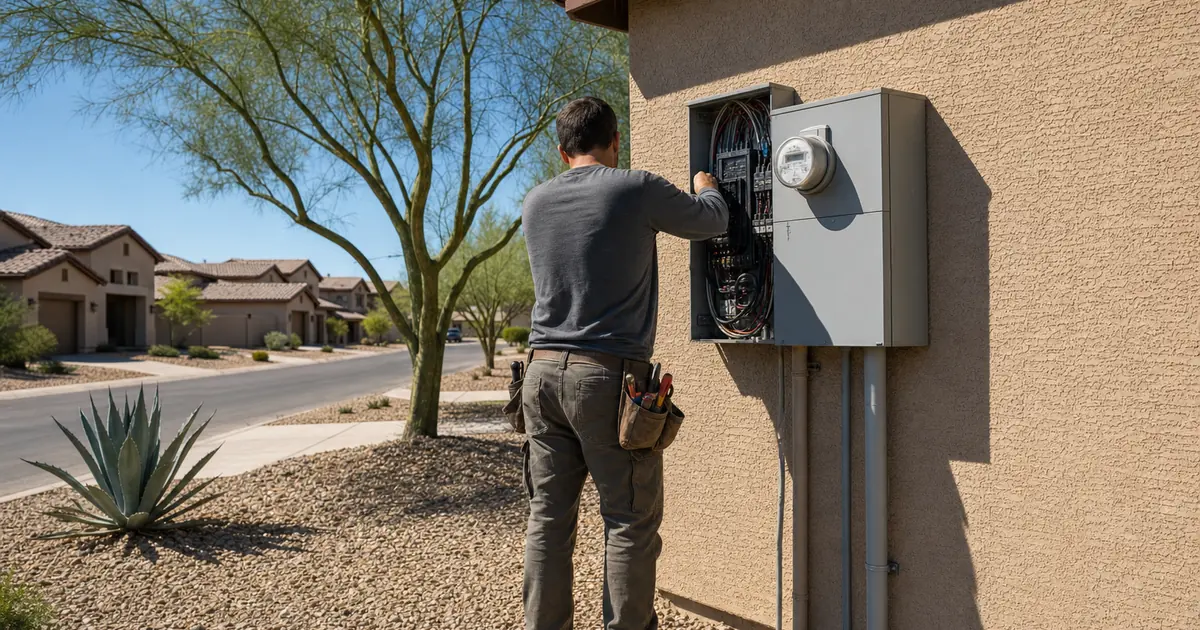
Residential electrical service - Chandler, Arizona
Electrician in Chandler by Area: Neighborhoods, Planning Areas and Historic Districts (2026 Guide)
How the City's own planning map, its historic districts, HOA rules and the SRP or APS split shape home electrical work in each part of Chandler.
Quick answer
Electrical work in Chandler follows the same code, permit office and inspection line at every address, whatever the neighborhood. The City applies the 2023 National Electrical Code to plans submitted on or after July 1, 2025. Area matters in three places: designated historic properties need Historic Preservation review for exterior changes, the Southeast Chandler Area Plan encourages dark-sky lighting, and Arizona law stops HOAs from banning solar. SRP or APS serves each address, so check the bill.
Searching "electrician Chandler by area" usually comes down to one question: does the part of Chandler you live in change how electrical work is done? Mostly it does not. Every address inside city limits works under the same adopted code, the same City permit office and the same inspection line. The differences that do exist come from the City's own planning documents and from Arizona law: a small set of locally designated historic places downtown, a lighting preference written into the Southeast Chandler Area Plan, and state solar-rights rules that limit what a homeowners association can forbid.
This hub follows the City's official map of itself, the 2026 General Plan and its area plans, rather than marketing names for subdivisions. It explains what each kind of area means for a panel, a meter, a charger or outdoor lighting, and where to check before any work starts.
Key takeaways
- The City of Chandler's 2026 General Plan describes Chandler as 65.75 square miles, fully within Maricopa County and approximately 94% built out.
- Every Chandler address works under the same adopted code, the 2024 International Codes with the 2023 National Electrical Code for plans submitted on or after July 1, 2025, and the same Development Services permit office.
- The City's Downtown Region Area Plan covers 2.4 square miles in five districts and lists the region's historic places, including the Silk Stocking Historic Preservation District and the Southside Village Historic Conservation District.
- Chandler's Historic Preservation Design Guidelines (May 2023) say exterior mechanical, electrical and solar equipment on historic properties should go in the least visible place possible.
- The Southeast Chandler Area Plan, covering 14.5 square miles south of Ocotillo Road and east of Arizona Avenue according to the General Plan, encourages lighting that complies with dark sky policies.
- Under Arizona statute A.R.S. 33-1816, a homeowners association may set reasonable placement rules for a solar energy device but may not prohibit one.
How does the City of Chandler divide itself into neighborhoods and planning areas?
The City's 2026 General Plan describes Chandler as an incorporated area of 65.75 square miles in the southeast valley, fully within Maricopa County, and says the city is approximately 94% built out, with only about six percent of its land left undeveloped. According to the City, Council adopted the plan on February 23, 2026, and voters ratified it on July 21, 2026, with 83.94% in favor. The City calls the General Plan "the foundation upon which all development decisions are based", which makes it the most reliable map of how Chandler sorts its own land.
The plan groups land into four broad use categories. The one that matters most for homeowners is Neighborhoods, where the plan says residential is the predominant land use; the others are Regional Commercial, Employment, and Recreation and Open Space. On top of those categories sit area plans, which the City says begin to carry out the General Plan's goals in specific places and do not cover the whole city:
- Downtown Region Area Plan, covering the historic downtown and its surrounding districts.
- Chandler Airpark Area Plan, covering 7.35 square miles around Chandler Municipal Airport.
- Southeast Chandler Area Plan, covering 14.5 square miles south of Ocotillo Road and east of Arizona Avenue.
- The City also names a South Arizona Avenue Corridor Area Plan, adopted January 17, 2008, and a Santan Freeway Corridor Area Plan.
The General Plan also marks four growth areas, mostly commercial and employment corridors: North Arizona Avenue, the South Price Road Corridor south of the Loop 202 freeway, North Price Road around the regional mall, major employers and medical services, and West Chandler along I-10 and Loop 202. Subdivision and community names are not part of this map, and no City page we read describes individual master-planned communities, so this page does not either. When a Chandler homeowner gives us an address, we place it on the City's planning map first, because that map, not a subdivision name, is what the City's rules refer to.
Does the electrical code or permit process change from one Chandler neighborhood to another?
No. The adopted code, the permit office and the inspection line are the same at every address in the city. The City of Chandler says it has amended and adopted the 2024 editions of the International Codes with the 2023 edition of the National Electrical Code, and that all plans submitted for review on or after July 1, 2025, must comply with those editions. No area plan or neighborhood designation we read sets a different electrical code.
Permits and inspections run through Development Services at 215 E. Buffalo St., open Monday through Friday from 8 a.m. to 5 p.m. Fees are paid through the City's Citizen Access Portal, and permit status and inspections can be followed at developmentpermits.chandleraz.gov/clics. The numbers homeowners use most are:
- Chandler Permits: 480-782-3074 (rod@chandleraz.gov).
- Plan Reviewer of the Day: 480-782-3078.
- Inspection line: 480-782-3100; a call before midnight requests a next-day inspection.
Because the rules are citywide, a service upgrade inside the Southeast Chandler Area Plan goes through the same permit and inspection as one downtown; our electrical panel upgrade guide walks through that sequence. Smaller jobs are less clear-cut. Whether swapping a breaker or a device needs a permit depends on the job, so ask Chandler Permits at 480-782-3074 before the work starts rather than assuming either way. What does change by area is a short list of extra steps that sit beside the permit, never in place of it: historic-preservation review on designated properties, the lighting guidance in one area plan, and the limits Arizona law puts on homeowners association rules for solar.
How big are Chandler's area plans compared with the whole city?
Area plans are smaller than many homeowners expect. The chart compares the city's incorporated area with the three area plans whose sizes the City publishes. The Downtown Region Area Plan, which holds every historic designation discussed below, covers 2.4 square miles. The plan areas sit inside the city total and cover only parts of it, so their sizes are not added together.
| Area | Square miles | Size relative to the city's 65.75 sq mi (our arithmetic) | Source |
|---|---|---|---|
| City of Chandler (incorporated) | 65.75 | 100% | City of Chandler 2026 General Plan, p.19 |
| Southeast Chandler Area Plan | 14.5 | 22.1% | City of Chandler 2026 General Plan, p.49 |
| Chandler Airpark Area Plan | 7.35 | 11.2% | City of Chandler 2026 General Plan, p.49 |
| Downtown Region Area Plan | 2.4 | 3.7% | Downtown Region Area Plan, Chapter 1 |
How we got this table. The sizes come from the City of Chandler 2026 General Plan (pages 19 and 49) and Chapter 1 of the Downtown Region Area Plan, read November 27, 2026. The third column is our arithmetic: each plan's square miles divided by the city's 65.75, rounded to one decimal place. It shows scale only; it is not a statement that a plan lies wholly inside city limits. The City says area plans do not cover the whole city, so the rows are not added together.
The practical reading is that each area plan covers a defined slice of the city. If your address is outside all of them, the citywide rules alone apply; if it is inside one, the plan's own text, not the neighborhood's reputation, says what is different.
What should Downtown Chandler homeowners know before electrical work?
The Downtown Region Area Plan says the downtown region covers 2.4 square miles that is primarily built out, and divides it into five districts, or character areas, with distinct boundaries: Northern, Eastern, Southern, San Marcos and Downtown. In the General Plan's summary, the downtown plan uses infill, residential with integrated uses and adaptive reuse to preserve and enhance what the City calls a beloved downtown.
The same plan lists the region's historic places: Historic Downtown, the Silk Stocking Historic Preservation District, the Southside Village Historic Conservation District, Historic Chandler High School and the Historic San Marcos Hotel. That list is why downtown is the part of the city where homeowners most often need a historic-preservation answer before exterior electrical work.
Living downtown does not by itself make a home historic, though. Chandler's designations attach to particular districts and properties; in the Silk Stocking overlay, for example, the City designated the properties whose owners signed waivers. For a downtown house that is not designated, the work follows the citywide permit and code described above. For one that is, the next section applies. Interior work such as a new circuit, a replaced outlet or a panel change is still a permit question first; the design-guideline passages cited on this page concern exterior equipment and how visible it is.
What extra step applies to electrical work on a historic home in Chandler?
On a locally designated property, alterations go through the City's Historic Preservation program alongside the building permit. The City's Historic Preservation page lists designations that include:
- The Southside Village Historic Conservation District, designated in July 2022, the first designation under the program.
- The Silk Stocking Neighborhood, a Historic Preservation District zoning overlay.
- A heritage site, the Chandler Heights Citrus Camp.
- A landmark, the McCullough-Price House.
The City defines an overlay as a zoning overlay of an area designated by the City Council containing one or more historic properties. Its April 16, 2024 news release says Council established the Silk Stocking overlay within a portion of downtown's Silk Stocking neighborhood, with 23 designated properties whose owners signed waivers and 39 homes counted as contributing properties. The release names the architectural styles as mostly Early Ranch, along with Craftsman, Ranch and Spanish Colonial Revival. Participating owners follow the ordinance and the City's design guidelines for property maintenance, repair and rehabilitation.
The City describes the process this way: the owner applies, and the Historic Preservation Officer may issue a Certificate of No Effect or a Certificate of Appropriateness, or deny the application, which can be appealed. The Historic Preservation Commission reviews landmark, district and heritage-site applications, and City Council takes final action on those.
The City's Historic Preservation Design Guidelines (May 2023) are the clearest guide for electrical equipment on these properties:
- Mechanical, electrical, solar or other exterior equipment should go in the least visible place possible, and screening or boxing is encouraged depending on its location.
- Roof-mounted equipment should sit on the rear roof slope, behind the roof's midpoint.
- Solar panels that generate electricity for the home can be installed on historic properties, placed so they are minimally visible or not visible.
- Minor facade changes not visible from the street right-of-way, small work items that do not affect historic character, and roof-mounted solar that meets the general guidelines are listed as eligible for an over-the-counter Certificate of No Effect.
The guidelines do not name meters, panels, exterior lights or EV chargers specifically, and no City page we read says which of those needs a Certificate of Appropriateness. Before exterior electrical work on a designated property, check with Historic Preservation through the City at 480-782-2000. On Chandler jobs at designated addresses we look at the equipment location from the street first, because the least visible wall is usually decided before any wire is pulled.
How does the Southeast Chandler Area Plan affect outdoor lighting?
The Southeast Chandler Area Plan, adopted by Resolution No. 3119 in 1999, covers 14.5 square miles south of Ocotillo Road and east of Arizona Avenue, using the General Plan's description of its boundary. The plan says it preserves the agricultural atmosphere of the community and creates open spaces, and it describes the intended development character as rural-oriented, calm, friendly and safe.
For electrical work, the relevant line is about light. The plan says lighting that complies with dark sky policies is encouraged, and it calls on the City to review its street light standards. That is policy guidance written into a plan, not a permit condition the plan states, and the plan text we read does not set fixture limits for private homes. It is still worth weighing when you choose fixtures for a yard, a driveway or a patio inside the plan area. In our reading of the plan's intent:
- Shielded fixtures that aim light down fit better than bare, upward-spilling floodlights.
- Motion-activated security lights put light where it is needed without lighting the sky all night.
- Path and landscape lights can be kept low and aimed at the ground they are meant to light.
If you live in a homeowners association inside the plan area, the association's own community documents may also set lighting rules. Our pages on outdoor and security lighting in Chandler and landscape lighting in Chandler cover fixtures, circuits and controls in more detail.
Can a Chandler HOA stop you from installing solar or other electrical equipment?
For solar, Arizona law limits what an association can do. A.R.S. 33-1816 says that, notwithstanding the community documents, an association shall not prohibit the installation or use of a solar energy device. It may adopt reasonable rules about placement, but only if those rules do not prevent installation, impair the device's functioning, restrict its use, or adversely affect its cost or efficiency. A separate statute, A.R.S. 33-439, makes deed and contract covenants that effectively prohibit a solar energy device void and unenforceable, although instruments entered into before April 17, 1980, are not covered by that section.
Those statutes are about solar energy devices. Our research did not find an Arizona statute giving homeowners a comparable right for EV chargers, so this page does not claim one. For a charger, an exterior subpanel, a generator or new outdoor lighting, the association's community documents decide what needs its approval, and the City permit applies as well wherever the work calls for one. Plan around both; the EV charger installation page covers the electrical side.
Chandler also works with associations directly. The City's HOA Matching Assistance Program is open only to HOAs and lists entry signs, painting of planned development perimeter walls, enhancement of landscaping in common areas, and addressing safety concerns as eligible projects; the program page we read lists no lighting category. Neighborhood Programs can be reached at 480-782-4363. When an HOA homeowner asks us about exterior equipment, we ask for the architectural rules early, because a location the association rejects means moving conduit later.
Which electric utility serves your part of Chandler, SRP or APS?
Electricity in Chandler comes from either SRP or APS, depending on the address, not from the City. The City's ballot material on the APS franchise refers to Chandler voters outside the APS service territory, which tells you APS serves only part of the city. No City or utility source we read says which streets, neighborhoods or planning areas fall on which side, so this page does not guess, and neither should a contractor.
The reliable check is the name on your electric bill. Without a bill to hand, SRP's service-area page offers an address lookup tool. The answer matters most for work that touches the service, such as a panel or service upgrade, a meter move, or anything that needs the power disconnected at the meter, because those jobs are coordinated with whichever utility serves the address. We read the name on the bill rather than guessing from the street, since two homes in the same part of the city cannot be assumed to share a utility. A side-by-side of the two is on SRP and APS in Chandler explained.
What changes for electrical work, area by area in Chandler?
The table brings the sections above together. It starts from the citywide rule and adds only the extra steps that a City document or an Arizona statute attaches to a kind of area, with the place to ask about each.
| Area type | Official example | Extra step beyond the City permit | Who to ask (our reading) |
|---|---|---|---|
| Any Chandler address | Citywide | None: 2023 NEC as adopted, one permit office, one inspection line | Chandler Permits, 480-782-3074 |
| Locally designated historic property | Silk Stocking HP District overlay; Southside Village Historic Conservation District; McCullough-Price House landmark; Chandler Heights Citrus Camp heritage site | Alterations reviewed by the Historic Preservation Officer (Certificate of No Effect or Certificate of Appropriateness); exterior equipment in the least visible place; solar minimally or not visible | City of Chandler, 480-782-2000 |
| Southeast Chandler Area Plan | South of Ocotillo Road, east of Arizona Avenue | Plan encourages dark-sky-compliant lighting (policy guidance, not a stated permit rule) | The plan text |
| HOA community | Any homeowners association | HOA may set reasonable solar placement rules but may not prohibit solar; other exterior work per community documents | The association; Neighborhood Programs, 480-782-4363, for HOA grants |
| Downtown Region | Northern, Eastern, Southern, San Marcos and Downtown districts | Holds the designated historic places above; otherwise citywide rules | City of Chandler, 480-782-2000, for designation questions |
| Electric utility | SRP or APS, by address | Service work coordinated with whichever utility serves the address | Name on the bill, or SRP's address lookup |
How we got this table. This matrix is our own arrangement of the City of Chandler planning, historic-preservation and building-safety documents and the two Arizona statutes listed under References, read November 27, 2026. The extra-step column summarizes each source; the who-to-ask column is our reading of the contact each source gives. It is not measured data. No source we read says which areas SRP or APS serve, or which exterior electrical items need a Certificate of Appropriateness, so neither is shown.
What are the most common mistakes when planning electrical work by area in Chandler?
- Assuming a neighborhood has its own electrical code. The 2023 National Electrical Code as adopted by the City applies at every Chandler address; the area differences are review steps, not a different code.
- Assuming every downtown home is historic. Designation attaches to specific districts and properties. Check the City's Historic Preservation list rather than judging by the street.
- Placing exterior equipment on a designated home before asking. The City's guidelines put exterior electrical and solar equipment in the least visible place possible. Ask the City at 480-782-2000 first.
- Treating an HOA solar rule as a ban. Arizona law lets an association set reasonable placement rules for solar but not prohibit it.
- Assuming an HOA must allow an EV charger. We found no comparable state statute; the community documents decide.
- Guessing the utility from the neighborhood. Read the name on the bill or use SRP's address lookup.
For a whole-house check before buying or remodeling in any part of the city, see home electrical inspections in Chandler.
Who does the electrical work in every Chandler neighborhood?
The same contractor and the same rules apply across the city, which keeps the work predictable from one planning area to the next. What varies is the paperwork around it: a historic-preservation application on a designated property, an HOA approval in a planned community, and the utility coordination that follows whichever of SRP or APS serves the address.
Before hiring anyone, ask who will pull the City of Chandler permit, whether they have checked if the property is historically designated, and whether they have confirmed the serving utility from the bill. Those three answers cover the area-specific questions on this page.
Electrical work requested through Your Chandler Electrician is performed by Alvey Electric LLC, Arizona Registrar of Contractors license ROC 364723 (R-11, residential). The work is residential only, at homes in the City of Chandler.
Frequently asked questions
Does the neighborhood I live in change the electrical code in Chandler?
No. The City of Chandler applies the 2023 National Electrical Code, adopted with the 2024 International Codes, to plans submitted on or after July 1, 2025, at every address, and permits and inspections run through the same Development Services office at 215 E. Buffalo St. What changes by area are extra review steps: Historic Preservation review on designated properties, the Southeast Chandler Area Plan's dark-sky lighting guidance, and HOA approval in planned communities, where Arizona law limits solar restrictions.
What extra step applies to electrical work on a historic home in Chandler?
On a locally designated property, alterations go to the City's Historic Preservation Officer, who may issue a Certificate of No Effect or a Certificate of Appropriateness, or deny the application, which can be appealed. The City's May 2023 design guidelines say exterior mechanical, electrical and solar equipment should go in the least visible place possible. The guidelines do not name meters, panels or chargers specifically, so call the City at 480-782-2000 before exterior electrical work.
How do I find out if my Chandler home is in a historic district?
Check the City of Chandler's Historic Preservation page, which lists the designations, including the Southside Village Historic Conservation District, the Silk Stocking Neighborhood Historic Preservation District overlay, the Chandler Heights Citrus Camp heritage site and the McCullough-Price House landmark. Being downtown does not make a home historic by itself, because designation applies to specific districts and properties. If you are unsure, the City lists 480-782-2000 for historic preservation questions.
Can my HOA in Chandler stop me from installing solar panels?
No. Arizona statute A.R.S. 33-1816 says an association shall not prohibit the installation or use of a solar energy device, notwithstanding the community documents. The association may adopt reasonable placement rules, but only if they do not prevent installation, impair the device's functioning, restrict its use, or adversely affect its cost or efficiency. A.R.S. 33-439 also voids deed covenants that effectively prohibit solar, except instruments entered into before April 17, 1980.
Does a Chandler HOA have to allow an EV charger?
This page does not say so, because our research found no Arizona statute giving homeowners an EV-charger right comparable to the solar laws. The association's community documents decide which exterior changes need its approval, so read them and ask the HOA before ordering equipment. The City of Chandler electrical permit is a separate step that applies wherever the work requires one, whatever the HOA decides.
SRP or APS - does it matter for electrical work in my part of Chandler?
It matters for any job that touches the service, such as a panel upgrade or a meter move, because that work is coordinated with whichever utility serves the address. Chandler is served by both SRP and APS, and APS serves only part of the city. No source we read maps the split by neighborhood, so read the name on your electric bill or use SRP's address lookup instead of guessing.
What does the Southeast Chandler Area Plan say about outdoor lighting?
The plan, adopted in 1999 and covering 14.5 square miles south of Ocotillo Road and east of Arizona Avenue, says lighting that complies with dark sky policies is encouraged and asks the City to review its street light standards. That is policy guidance rather than a permit condition stated in the plan. Shielded, downward-aimed fixtures and motion-activated security lights are a practical way to stay within its intent.
How much does electrical work cost in different Chandler neighborhoods?
This page does not quote prices because no public source sets them, and nothing we read says cost varies by neighborhood as such. What moves the cost is the job: its scope, whether a historic-preservation application or HOA approval adds design time, whether equipment has to be placed or screened to stay out of view, how far the wiring has to run, and the City permit fee. A written estimate after a site visit is the reliable figure.
Where do I get an electrical permit in Chandler?
From City of Chandler Development Services at 215 E. Buffalo St., open Monday through Friday from 8 a.m. to 5 p.m. Fees are paid through the Citizen Access Portal, permit status is tracked at developmentpermits.chandleraz.gov/clics, and Chandler Permits answers at 480-782-3074. Inspections are requested on 480-782-3100, and a call before midnight is for the next day. If you are unsure whether a small job such as a breaker swap needs a permit, ask Permits first.
Can Chandler HOA matching grants pay for neighborhood lighting?
The City's HOA Matching Assistance Program page lists entry signs, painting of planned development perimeter walls, enhancement of landscaping in common areas and addressing safety concerns as eligible projects, and the neighborhood must be an HOA. The page we read lists no lighting category, so whether a lighting project could qualify is a question for Neighborhood Programs at 480-782-4363 or neighborhood.programs@chandleraz.gov.
How big is the Downtown Chandler area plan?
The Downtown Region Area Plan covers 2.4 square miles that the plan describes as primarily built out. It is divided into five districts with distinct boundaries, Northern, Eastern, Southern, San Marcos and Downtown, and lists historic places including Historic Downtown, the Silk Stocking Historic Preservation District, the Southside Village Historic Conservation District, Historic Chandler High School and the Historic San Marcos Hotel.
Who does the electrical work requested through Your Chandler Electrician?
Electrical work requested through Your Chandler Electrician is performed by Alvey Electric LLC, Arizona Registrar of Contractors license ROC 364723 (R-11, residential). The same contractor and the same City of Chandler permit rules apply in every Chandler neighborhood and planning area, from the Downtown Region to the Southeast Chandler plan area. The work is residential only.
The short version
Start from the citywide baseline: one adopted code, one permit office and one inspection line for every Chandler address. Then ask three questions in order: is the property historically designated, is it in an HOA or the Southeast Chandler plan area, and whose name is on the electric bill. Any yes adds a step beside the permit, never one that replaces it.
This page is general information about residential electrical work in Chandler, Arizona. It is not engineering, legal or code advice for a specific property. Permit rules, utility requirements and adopted codes change; confirm current requirements with the City of Chandler and your electric utility before work begins.
References
- City of Chandler, 2026 General Plan (city area, build-out, land-use categories, area plans, growth areas) https://www.chandleraz.gov/sites/default/files/departments/development-services/City-of-Chandler-2026-General-Plan.pdf. Read November 27, 2026.
- City of Chandler Planning and Zoning, General Plan and Area Plans (adoption, ratification, area plan list) https://www.chandleraz.gov/government/departments/development-services/planning-and-zoning/general-plan-and-area-plans. Read November 27, 2026.
- City of Chandler, Downtown Region Area Plan, Chapter 1 Overview (size, five districts, historic places) https://www.chandleraz.gov/sites/default/files/departments/development-services/City-of-Chandler-Downtown-Region-Area-Plan-Chapter-1-Overview.pdf. Read November 27, 2026.
- City of Chandler, Historic Preservation in Chandler (designations and overlay definition) https://www.chandleraz.gov/government/departments/development-services/planning-and-zoning/historic-preservation. Read November 27, 2026.
- City of Chandler News Center, Chandler establishes Historic Preservation District zoning overlay within Silk Stocking (April 16, 2024) https://www.chandleraz.gov/news-center/chandler-establishes-historic-preservation-district-zoning-overlay-within-silk-stocking. Read November 27, 2026.
- City of Chandler, Historic Preservation: How it works (Certificate of No Effect, Certificate of Appropriateness) https://www.chandleraz.gov/government/departments/development-services/planning-and-zoning/historic-preservation/how-it-works. Read November 27, 2026.
- City of Chandler, Historic Preservation Design Guidelines (May 2023) https://www.Chandleraz.gov/sites/default/files/City-of-Chandler-Historic-Preservation-Design-Guidelines-May-2023.pdf. Read November 27, 2026.
- City of Chandler, Southeast Chandler Area Plan (Resolution No. 3119, 1999) https://www.chandleraz.gov/sites/default/files/departments/development-services/City-of-Chandler-Southeast-Chandler-Area-Plan.pdf. Read November 27, 2026.
- Arizona Revised Statutes 33-1816, Solar energy devices; reasonable restrictions (planned communities) https://www.azleg.gov/ars/33/01816.htm. Read November 27, 2026.
- Arizona Revised Statutes 33-439, Solar energy devices; covenants void https://www.azleg.gov/ars/33/00439.htm. Read November 27, 2026.
- City of Chandler Neighborhood Programs, HOA Matching Assistance Program https://www.chandleraz.gov/residents/neighborhood-resources/neighborhood-preservation/neighborhood-programs/hoa-matching-grant. Read November 27, 2026.
- City of Chandler Development Services, Building Safety: plan review, permits and inspections (2024 International Codes and 2023 NEC; contacts) https://www.chandleraz.gov/government/departments/development-services/building-safety-plan-review-permits-and-inspections. Read November 27, 2026.
- City of Chandler, Granting a Franchise to Arizona Public Service Company (APS) ballot document https://www.chandleraz.gov/sites/default/files/departments/city-clerk/City-of-Chandler-Granting-a-Franchise-to-Arizona-Public-Service-Company-APS.pdf. Read November 27, 2026.
- Salt River Project, Service area and territory (address lookup) https://www.srpnet.com/about/service-area-territory. Read November 27, 2026.
Planning electrical work in your part of Chandler?
Describe your address and the job, and the estimate will start from the City permit, any historic or HOA step, and your utility.
Related pages
- Electrical panel upgrade in Chandler
- SRP and APS in Chandler explained
- Outdoor and security lighting in Chandler
- Landscape lighting in Chandler
- EV charger installation in Chandler
- Home electrical inspections in Chandler
- Electrical repair and troubleshooting in Chandler
- Your Chandler Electrician home
About this page
Written by the Your Chandler Electrician editorial team from the sources listed above. Reviewed by Robert "Bob" Lira, licensed Arizona electrical contractor, ROC 338369. Your Chandler Electrician, 2139 N Yucca Ct, Chandler, AZ 85224, phone 480-939-3336, serves homes in the City of Chandler. Electrical work is performed by Alvey Electric LLC, Arizona Registrar of Contractors license ROC 364723 (R-11, residential).
Updated .