Residential electrical service - Chandler, Arizona
Hot Tub Electrical Installation Chandler AZ: Pool and Spa Wiring Rules (2026 Guide)
How the City of Chandler permit, the equipment and barrier rules, bonding, GFCI protection and your utility shape a pool or spa wiring job.
Quick answer
Hot tub and pool wiring in Chandler is permit work. The City says all pools and spas need a permit, above or below ground, and it inspects to the 2023 National Electrical Code, whose pool and spa article Chandler applies without local changes. The City's manual also requires pool equipment to sit 5 feet from the water's edge and metal patio covers within 5 feet to be tied into the pool bonding. A load calculation decides whether the panel can carry a spa.
Hot tub electrical installation in Chandler, AZ, is permit work, and so is nearly everything electrical that sits beside a pool. The City of Chandler says all pools and spas need a permit whether they are built above or below ground, sets its own rules on where pools and their equipment can go, and inspects the wiring to the 2023 National Electrical Code as adopted. This guide is for owners of single-family homes inside Chandler city limits who are adding a spa, building a pool, replacing pool equipment, or trying to work out why a circuit near the water keeps tripping.
It covers the permit, the code, the bonding and ground-fault protection that keep people safe in the water, whether the panel can carry the new load, and where SRP or APS comes in. It does not quote prices; it explains what drives them.
Key takeaways
- The City of Chandler's homeowner permit manual says all pools and spas need a permit, whether built above or below ground, and lists prefabricated pools less than 18 inches deep as exempt.
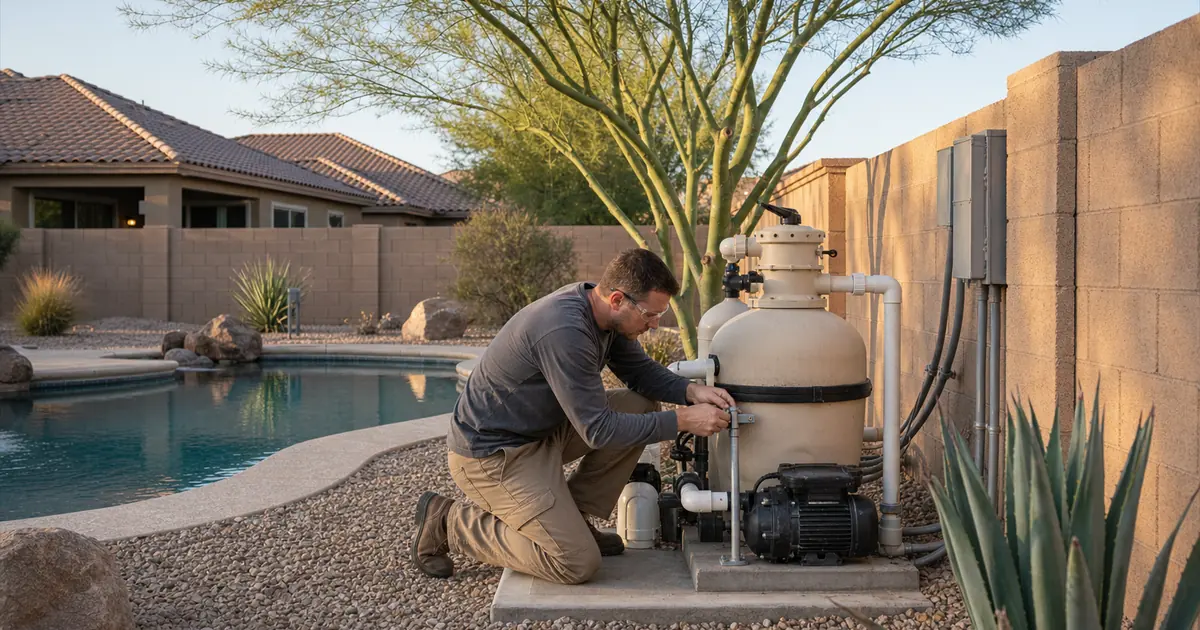
- Chandler's homeowner manual requires pool equipment to be 5 feet from the water's edge, which sets where the equipment pad and its circuits can go.
- According to the City's manual, metal patio covers within 5 feet of a Chandler swimming pool must be tied into the pool's equipotential bonding.
- Chandler has no local amendment to Article 680, so the 2023 National Electrical Code's pool and spa rules apply as written to plans submitted on or after July 1, 2025.
- Chandler requires a pool barrier at least 6 feet (72 inches) high, which is stricter than the 5-foot minimum in Arizona's statewide pool law.
- The U.S. Consumer Product Safety Commission says it is aware of 33 pool and spa electrocution deaths nationwide since 2002 and advises turning off all power before any rescue.
What does hot tub and pool wiring cover in a Chandler home?
Pool and spa wiring is more than running power to a pump. On a typical Chandler project it covers the circuits that feed the pool pump, heater, lights and automation equipment; the circuit for a hot tub; the ground-fault protection on those circuits; the receptacles and lighting around the water; and the equipotential bonding that ties the metal parts of the pool area together. All of it falls under Article 680 of the National Electrical Code, the part of the code written for swimming pools, spas and hot tubs.
The jobs homeowners ask about usually fall into a few groups:
- New pool construction. The pool builder handles the shell; an electrical contractor wires the equipment pad, lights and bonding, and the City inspects at set stages.
- Adding a hot tub or spa. Smaller portable tubs plug into a receptacle; larger spas are generally wired directly to their own circuit. Which kind you buy changes the scope and the permit question.
- Replacing or moving equipment. A new pump, heater or automation panel may need a different circuit, and moving the pad brings Chandler's distance rule into play.
- Lighting and receptacles. Pool lights and outdoor receptacles near the water follow the pool rules, not only the general outdoor rules.
- Troubleshooting. A tripping GFCI, a pump that will not start, or a tingle in the water each needs a diagnosis, and the last one needs the power off first.
Yard lighting away from the water is covered on landscape lighting in Chandler.
Does a hot tub or pool need a permit in Chandler?
Yes, in almost every case. The City of Chandler's Home Owners Building Permit Manual says all pools and spas require a permit, whether they are constructed above or below ground. The same manual defines a swimming pool, under the City code, as any body of water deeper than 18 inches, and it lists prefabricated pools less than 18 inches deep as exempt. Custom in-ground pools and spas also need engineering plans stamped and sealed by an engineer, and the City requires a separate building permit before pool fencing is built.
Several points from the City's manual and permit pages matter for the electrical side:
- Permitted work is done by a licensed contractor unless the owner-applicant performs the work personally.
- On a rented or leased home, a licensed contractor must pull the permit.
- The City charges a minimum permit fee, set out in the manual, and work done without a permit may be charged double fees.
- Fees are paid through the City's Citizen Access Portal, and permit status and inspections are tracked at developmentpermits.chandleraz.gov/clics.
One question the City's documents do not answer directly is a small plug-in hot tub. The manual says all spas need a permit, but it defines pools by depth and does not address a portable tub that plugs into an existing receptacle. If that is your plan, ask Chandler Permits at 480-782-3074 before you buy, and ask about the receptacle as well as the tub. The permit counter is at 215 E. Buffalo St., open Monday through Friday from 8 a.m. to 5 p.m. The same caution applies to small repairs near the pool, such as replacing a breaker: ask Permits whether your specific job needs a permit rather than assuming it does not.
Which electrical code applies to pools and hot tubs in Chandler?
Chandler has adopted the 2024 editions of the International Codes, including the International Swimming Pool and Spa Code, together with the 2023 National Electrical Code, with local amendments. The City says all plans submitted for review on or after July 1, 2025, must be designed to comply with those editions. The building regulations are adopted by Ordinance No. 5108 in Chapter 29 of the City Code.
The local electrical amendments are narrow. They add exceptions to ground-fault protection for receptacles that are not readily accessible and for listed air-conditioning, heating and cooling equipment, allow testing agencies approved by the City's building official, and delete item (10) of the tamper-resistant receptacle section. None of them touches Article 680. For pool and spa wiring, the inspector applies the 2023 National Electrical Code's pool and spa article as published.
Where Chandler does go further is outside the electrical code: in the pool barrier rules, the location rule and the equipment distance rule. Those rules decide where the electrical work can go, so they belong in the plan from the first site visit.
What are Chandler's pool and spa rules, and how do they affect the wiring?
The City's rules come from three places: its pool fencing page, its homeowner permit manual and its amendments to the 2024 pool and spa code. The chart puts the points that matter on a residential project in one view, with Arizona's statewide barrier minimum for comparison.
| Item | Chandler rule | Source | What it means for the electrical work (our reading) |
|---|---|---|---|
| Permit | All pools and spas, above or below ground; prefab under 18 in deep exempt | Homeowner manual | Pool and spa wiring is part of a permitted, inspected project |
| Pool location | Backyard only, not the front yard | City pool fencing page | Feeder and lighting circuits run from the house to the backyard |
| Equipment to water | At least 5 ft from the water's edge | Homeowner manual | The equipment pad and its circuits are placed from the water line, not from the panel |
| Metal patio cover | Within 5 ft: tied into pool equipotential bonding | Homeowner manual | Plan any cover before the deck is poured |
| Barrier height | 6 ft (72 in) minimum, 7 ft maximum; Arizona statewide minimum 5 ft | City pool fencing page; City ISPSC amendment; A.R.S. 36-1681 | Equipment and conduit are placed so they do not weaken the barrier |
| Gate latch | Higher than 54 in above grade | City pool fencing page | Gate lighting or hardware must leave the latch height intact |
| Fence openings | No 4-in sphere may pass; no hand or foot holds | City pool fencing page | Conduit and fixtures on the fence must not create a foothold |
| House doors to pool | Self-closing or UL 2017 audible alarm | Homeowner manual | If alarms are chosen, plan where they are mounted |
| Inspections | Pre-gunite, then pre-plaster; panels left unlocked | Homeowner manual | Leave the electrical panel unlocked on inspection days |
How we got this table. The rule and source columns summarize the City of Chandler pool fencing page, the Home Owners Building Permit Manual (Rev. 4/09/26), the City's amendments to the 2024 International Codes and Arizona Revised Statutes 36-1681, read in November 2026. The right-hand column is our own reading of how each rule shows up on the electrical side; it is not a City interpretation, and the inspector's decision governs. No Chandler document we read lists pool electrical plan items such as wire sizes or a bonding checklist, so none are shown.
Three of these rules land directly on the electrical work. The City requires pools to be in the backyard, which fixes where the feeder and lighting circuits will run. The manual says pool equipment must be 5 feet from the water's edge, so the pump, filter and heater location is set by the water line. And metal patio covers within 5 feet of a pool must be tied into the pool's equipotential bonding, so a cover project and a pool project have to be planned together.
The barrier rules matter because they decide where trenches, conduit and equipment can sit. Chandler says pools must be enclosed by a perimeter fence of masonry, concrete or decorative fencing at least six feet high and no more than seven, and it does not allow wood fencing. The City's amendment sets the barrier minimum at 72 inches, with a lower 48-inch minimum where the barrier separates the pool or spa from a one- or two-family dwelling. Arizona's statewide law sets a five-foot minimum and lets cities adopt rules that are equal or stricter, which Chandler has done; fences built before September 1986 have a 5 foot 6 inch minimum under the City page. Because the fence cannot offer hand or foot holds, we route conduit and mount fixtures so nothing on or against it becomes a step for a child.
What is pool bonding, and what has to be tied into it in Chandler?
Equipotential bonding connects the metal parts of a pool area, and the water itself, with conductors so they stay at the same electrical potential. If a fault puts voltage on one metal part, bonding keeps a large voltage difference from appearing between that part, the water and the deck, and that difference is what drives current through a person. Bonding is separate from grounding and from GFCI protection; a pool needs all three, and none substitutes for another.
Article 680 of the 2023 National Electrical Code sets out what has to be connected and how, and Chandler applies it without local changes. The City adds one rule of its own in the homeowner manual: metal patio covers within 5 feet of a swimming pool must be connected to the pool's equipotential bonding. That rule catches homeowners who add a cover after the pool is finished, when the bonding conductors are already under the deck.
On Chandler pool jobs we walk the whole yard before we draw anything, looking for metal near the water the original plan may have missed: a patio cover, a railing, a fence section or an equipment stand. Tying those items in while the deck is open is far simpler than cutting concrete later.
Why do GFCI protection and shock safety matter around a pool or hot tub?
The U.S. Consumer Product Safety Commission says it is aware of 33 fatalities nationwide since 2002 that involved electrocutions in swimming pools and spas. CPSC warns that swimmers in electrified water may feel tingling, have muscle cramps or be unable to move at all, and that the first step is to turn off all power immediately, because rescuers who enter energized water can become victims too.
A ground-fault circuit interrupter, or GFCI, is the main defense on the circuits themselves. It trips when it senses ground-fault current, meaning current leaking to ground instead of returning on the circuit's own conductors, which often happens when moisture reaches equipment or a cord. The Electrical Safety Foundation International advises using GFCI protection for electrical devices used outside, keeping electrical devices and cords at least 10 feet away from water, making sure no power lines run over a swimming pool, and having an electrician inspect and upgrade a pool, spa or hot tub.
A GFCI that trips is doing its job until proven otherwise. Repeated resets hide the cause, which may be a failing motor, a wet connection, a damaged cord or a worn light. When we troubleshoot a tripping pool or spa circuit in Chandler, we isolate each piece of equipment in turn rather than replacing the GFCI first, because the device is usually reporting a fault somewhere else. Tripping receptacles elsewhere in the house are covered on outlet installation and repair in Chandler.
Can your Chandler electrical panel handle a hot tub or new pool equipment?
Sometimes yes, sometimes no, and a load calculation is the way to know. A hard-wired spa, a pool heater, a larger pump and new lighting all add load to a service that is already carrying air conditioning through a long summer. The question is not whether there is an empty breaker slot but whether the service as a whole has room for the new load alongside everything else.
If the calculation shows the service is too small, the options are a service upgrade or a change in plan, such as a smaller heater. A service upgrade brings in the utility. SRP's electric service specifications ask customers to contact both SRP and the City before any panel modification, and they list added load among the changes SRP treats as a modification needing approval. APS coordinates service upgrades through its Control Desk and needs three days' advance notice to de-energize a service outside an emergency. The full process is on electrical panel upgrade in Chandler.
On Chandler spa installs we run the load calculation with the pool pump, any heater and the spa all included, because a spa added beside a pool shares the service with that equipment. Neither utility re-energizes a modified service until the City has approved the work.
SRP or APS: does your utility matter for pool and spa wiring in Chandler?
It matters most when the job changes the service. Chandler runs no electric utility of its own; the City lists SRP and APS as the electric providers, and its APS franchise document shows APS serves only part of the city. No public source we read maps which streets fall on which side, so read the name on your electric bill.
The utility also matters for running costs. SRP's pool advice is to run the pump somewhere between eight and 12 hours a day in summer and six to eight hours in winter, to put it on a timer, and to consider a time-of-use price plan with the pump running off-peak. APS customers should check their own plan with APS before setting a schedule; this page does not list either utility's on-peak hours. A timer or automation controller matched to your plan is a small wiring job worth including. More on both utilities is on SRP and APS in Chandler explained.
| Job | Permit question | City document | SRP address (our reading) | APS address (our reading) |
|---|---|---|---|---|
| New in-ground pool or spa | Permit required; stamped engineering plans for custom builds | Homeowner manual | Contact SRP and the City before any service change; added load counts as a modification | Any service upgrade through the APS Control Desk; 3 days' notice to de-energize |
| Above-ground pool deeper than 18 in | Permit required | Homeowner manual | Same as above if the service changes | Same as above if the service changes |
| Prefab pool under 18 in deep | Listed as exempt | Homeowner manual | Only if the service changes | Only if the service changes |
| Plug-in portable hot tub | Not answered directly; ask Permits at 480-782-3074 | Homeowner manual (all spas need a permit) | Only if the service changes | Only if the service changes |
| Hard-wired spa on a new circuit | Permit required (all spas) | Homeowner manual | Ask SRP whether the added load needs review | Control Desk only if the service is upgraded |
| Breaker or pump-circuit repair | Ask Permits at 480-782-3074 | Amendments to the 2024 codes and homeowner manual | Only if the service changes | Only if the service changes |
| Metal patio cover within 5 ft | Must be tied into pool equipotential bonding | Homeowner manual | No utility step in the documents we read | No utility step in the documents we read |
How we got this table. This matrix is our own arrangement of the City of Chandler Home Owners Building Permit Manual (Rev. 4/09/26), the City's amendments to the 2024 International Codes, SRP's Electric Service Specifications section 1 and APS's Electric Service Requirements Manual section 100, read in November 2026. The two utility columns are our reading of those documents, not a ruling by SRP or APS. No source we read says which parts of Chandler each utility serves or whether a plug-in spa needs a permit, so neither is answered here.
How do pool inspections work in Chandler, and what should homeowners prepare?
The City inspects a pool in stages. The homeowner manual says the first inspection is the pre-gunite inspection, and no one needs to be home for it. The pre-plaster inspection follows, and the homeowner must be present if the house forms part of the barrier or there is no interior pool fence. The manual also says all electrical service panels must be left unlocked for the inspector.
Inspections are requested on the City's line at 480-782-3100, where a request made before midnight is for the next day, or by text at 844-281-3520 at least one business day ahead. The manual requires exterior doors from the house into the pool area to be self-closing or fitted with audible alarms listed to UL 2017, hinged doors to open away from the pool area, and windows facing the pool enclosure to have a latching device. The City's amendment adds rules for emergency escape windows facing the enclosure and for pet doors that can be latched inoperable.
Comparing CPSC's own figures, drowning is the larger risk around home pools. CPSC reports that an average of 376 children under 15 died each year from 2021 to 2023 in pool- or spa-related drownings nationwide, that over 70 percent of fatal drownings occurred in residential settings, and that about 5,900 nonfatal drowning injuries a year were treated in emergency departments from 2023 to 2025. CPSC advises layers of protection, including barriers, and the Chandler Fire Department adds self-closing, self-latching gates, latches out of children's reach and a designated Water Watcher; Chandler Fire's number is 480-782-2120. For a wider check of the house before a pool project, see home electrical inspections in Chandler.
What are the most common mistakes with hot tub and pool wiring in Chandler?
- Setting equipment by the panel instead of by the water. Chandler's manual requires pool equipment to be 5 feet from the water's edge.
- Adding a metal patio cover without tying it in. Covers within 5 feet of the pool must join the equipotential bonding, which is hardest once the deck is poured.
- Assuming a plug-in hot tub needs nothing. The City says all spas need a permit; ask Chandler Permits about a portable tub before buying.
- Resetting a tripping GFCI over and over. The trip signals ground-fault current; find the cause.
- Running pool gear on extension cords. ESFI advises keeping electrical devices and cords at least 10 feet from water.
- Locking the panel on inspection day. The City asks that all electrical service panels be left unlocked for the inspector.
Who does hot tub and pool electrical work in Chandler?
Arizona licenses contractors through the Registrar of Contractors. Chandler's homeowner manual says permitted work is done by a licensed contractor unless the owner-applicant does it personally, and a rented or leased home needs a licensed contractor to pull the permit. Before hiring anyone, ask for the license number and classification, who will take out the City of Chandler permit, how the equipment location meets the 5-foot rule, and whether the load calculation includes everything on the pool and spa side.
Hot tub and pool wiring requested through Your Chandler Electrician is performed by Alvey Electric LLC, Arizona Registrar of Contractors license ROC 364723 (R-11, residential). The work is residential only.
Frequently asked questions
Does a hot tub or pool need a permit in Chandler?
Yes, in almost every case. The City of Chandler's Home Owners Building Permit Manual says all pools and spas require a permit, whether built above or below ground, and defines a pool as any body of water deeper than 18 inches. Prefabricated pools less than 18 inches deep are listed as exempt. For a small plug-in hot tub the City documents give no direct answer, so ask Chandler Permits at 480-782-3074 before you buy.
How much does hot tub or pool wiring cost in Chandler?
This page does not quote prices because no public source sets one. The City charges a minimum permit fee, listed in its homeowner manual, and unpermitted work may be charged double fees. Beyond that, cost depends on the distance from the panel to the equipment pad, whether the service needs an upgrade, how much bonding work the deck and any metal patio cover need, the trenching, and the equipment itself. A written estimate after a site visit and a load calculation is the reliable figure.
SRP or APS - does it matter for hot tub or pool wiring?
It matters most when the job changes the service. Chandler is served by SRP and APS, and APS serves only part of the city, so read the name on your bill. SRP asks to be contacted along with the City before any panel modification and counts added load as a modification; APS handles service upgrades through its Control Desk with three days' notice to de-energize. For running costs, SRP suggests a pump timer and a time-of-use plan; APS customers should check their own plan.
How far does pool equipment have to be from the water in Chandler?
The City of Chandler's Home Owners Building Permit Manual says pool equipment must be 5 feet from the water's edge. That sets where the pump, filter and heater pad can go, and so where the circuits from the house end. The rule comes from the City's manual rather than a local electrical amendment, so plan the pad location with both the pool builder and the electrical contractor before any trench is dug.
What is pool bonding, and what has to be connected to it?
Equipotential bonding connects the metal parts of a pool area and the water so they stay at the same electrical potential, which keeps a dangerous voltage difference from forming between them. Article 680 of the 2023 National Electrical Code, applied in Chandler without local changes, sets what must be connected. Chandler's homeowner manual adds that metal patio covers within 5 feet of a swimming pool must be tied into the pool's equipotential bonding.
Why does my hot tub GFCI keep tripping?
A GFCI trips when it senses ground-fault current, meaning current leaking to ground, often because moisture has reached a connection, a motor, a heater or a cord. Repeated tripping is a warning, not a nuisance to reset around. Turn the circuit off, keep people out of the water, and have the equipment tested piece by piece. Replacing the GFCI alone does not fix a fault elsewhere in the equipment.
What electrical code applies to pools and spas in Chandler?
Chandler has adopted the 2024 International Codes, including the International Swimming Pool and Spa Code, with the 2023 National Electrical Code, for plans submitted on or after July 1, 2025. Chandler's local electrical amendments cover GFCI exceptions, approved testing agencies and item (10) of the tamper-resistant receptacle section. There is no local amendment to Article 680, so the pool and spa article applies as written.
How high does a pool fence have to be in Chandler?
The City says pool fencing must be at least six feet high and no more than seven feet, built of masonry, concrete or decorative fencing, not wood. The City's pool and spa code amendment sets the barrier minimum at 72 inches, with 48 inches where the barrier separates the pool from a one- or two-family dwelling. Arizona's statewide minimum is five feet, so Chandler's rule is stricter. Gate latches must be higher than 54 inches above grade.
Can I put a pool in my front yard in Chandler?
No. The City of Chandler says swimming pools must be located in the resident's backyard and cannot be in the front yard. The City also requires a building permit before pool fencing is built. For the electrical work, the backyard location sets where the equipment pad, feeder and lighting circuits will run, so the layout is planned around it from the start.
What should I do if someone gets a shock in a pool or hot tub?
Turn off all power to the pool or spa immediately, at the breaker or equipment disconnect, before anyone goes into the water. CPSC warns that if the power is not turned off, rescuers can become victims too, and that swimmers may feel tingling, cramp or be unable to move. Call 911. Keep the circuits off until a licensed electrician has found and fixed the cause.
Will a hot tub overload my electrical panel in Chandler?
It depends on the spare capacity a load calculation shows. A hard-wired spa adds a large load to a service that may already carry air conditioning, a pool pump and a heater. If the calculation shows too little room, the options are a service upgrade, which needs a City permit and coordination with SRP or APS, or a change in plan. A spare breaker slot is not proof of spare capacity.
Who does hot tub and pool electrical work in Chandler?
Hot tub and pool wiring requested through Your Chandler Electrician is performed by Alvey Electric LLC, Arizona Registrar of Contractors license ROC 364723 (R-11, residential). Chandler's homeowner manual says permitted work is done by a licensed contractor unless the owner-applicant performs it personally, and a rented or leased home needs a licensed contractor to pull the permit. The work is residential only.
The short version
Treat a pool or spa as one electrical project rather than a string of add-ons: place the equipment from the water line, include every pump, heater and spa in the load calculation, and settle any metal patio cover before the deck is poured. If the calculation says the service is too small, confirm SRP or APS from your bill before anything is ordered. When the job looks small, such as a plug-in tub or a breaker swap, ask Chandler Permits first instead of assuming no permit applies.
This page is general information about residential electrical work in Chandler, Arizona. It is not engineering, legal or code advice for a specific property. Permit rules, utility requirements and adopted codes change; confirm current requirements with the City of Chandler and your electric utility before work begins.
References
- City of Chandler Development Services, Pool fencing requirements (backyard location, fence height, gates, latches, openings) https://www.chandleraz.gov/government/departments/development-services/building-safety-plan-review-permits-and-inspections/pool-fencing-requirements. Read November 27, 2026.
- City of Chandler, Home Owners Building Permit Manual (Rev. 4/09/26) (pool and spa permits, equipment distance, patio cover bonding, inspections, doors and windows) https://www.chandleraz.gov/sites/default/files/departments/development-services/City-of-Chandler-Home-Owners-Building-Permit-Manual.pdf. Read November 27, 2026.
- City of Chandler, Amendments to the 2024 International Codes (Ordinance No. 5108; local NEC and ISPSC amendments) https://www.chandleraz.gov/sites/default/files/departments/development-services/City-of-Chandler-Amendments-to-the-2024-International-Codes.pdf. Read November 27, 2026.
- City of Chandler Development Services, Building Safety: plan review, permits and inspections (2024 International Codes and 2023 NEC; permits and inspection line) https://www.chandleraz.gov/government/departments/development-services/building-safety-plan-review-permits-and-inspections. Read November 27, 2026.
- Arizona Revised Statutes 36-1681, Swimming pool enclosures https://azleg.gov/ars/36/01681.htm. Read November 27, 2026.
- City of Chandler Fire Department, Water safety and drowning prevention https://www.chandleraz.gov/residents/fire/safety-education/water-safety-and-drowning-prevention. Read November 27, 2026.
- SRP blog, How to lower your pool energy costs (May 6, 2022) https://blog.srpnet.com/how-to-lower-your-pool-energy-costs/. Read November 27, 2026.
- U.S. Consumer Product Safety Commission, electrical safety in and around pools and spas https://cpsc.gov/safety-education/safety-guides/pools-and-spas/dont-swim-shocks-electrical-safety-and-around-pools. Read November 27, 2026.
- U.S. Consumer Product Safety Commission, report on childhood drowning risk (June 24, 2026) https://www.cpsc.gov/Newsroom/News-Releases/2026/CPSC-Report-Highlights-Persistent-Risk-of-Childhood-Drowning. Read November 27, 2026.
- Electrical Safety Foundation International, Pool and spa safety https://www.esfi.org/pool-and-spa-safety. Read November 27, 2026.
- City of Chandler Economic Development, Locate here (utilities: SRP, APS, Southwest Gas) https://www.chandleraz.gov/business/economic-development/locate-here. Read November 27, 2026.
- City of Chandler, Granting a Franchise to Arizona Public Service Company (APS) ballot document https://www.chandleraz.gov/sites/default/files/departments/city-clerk/City-of-Chandler-Granting-a-Franchise-to-Arizona-Public-Service-Company-APS.pdf. Read November 27, 2026.
- Salt River Project, Electric Service Specifications, section 1 general (panel modifications, added load, reconnection) https://SRPnet.com/assets/srpnet/pdf/doing-business/builders-developers-contractors/commercial-specifications-guidelines-and-handbooks/ESS-section-1-general.pdf. Read November 27, 2026.
- APS, Electric Service Requirements Manual, section 100 (energizing, seals, notice to de-energize) https://www.aps.com/-/media/APS/APSCOM-PDFs/About/Construction-and-Power-Line-Siting/Construction-Services/Electric-Service-Requirements-Manual/100.pdf. Read November 27, 2026.
- APS, Electric Service Requirements Manual, section 300 (service upgrades coordinated through the APS Control Desk) https://www.aps.com/-/media/APS/APSCOM-PDFs/About/Construction-and-Power-Line-Siting/Construction-Services/Electric-Service-Requirements-Manual/300.pdf. Read November 27, 2026.
Plan your pool or spa wiring
Request a load calculation and a written estimate for the hot tub or pool equipment at your Chandler home.
Related pages
About this page
Written by the Your Chandler Electrician editorial team from the sources listed above. Reviewed by Robert "Bob" Lira, licensed Arizona electrical contractor, ROC 338369. Your Chandler Electrician, 2139 N Yucca Ct, Chandler, AZ 85224, phone 480-939-3336, serves homes in the City of Chandler. Electrical work is performed by Alvey Electric LLC, Arizona Registrar of Contractors license ROC 364723 (R-11, residential).
Updated .