Residential electrical service - Chandler, Arizona
Smoke Detector Installation Chandler AZ: Hardwired, Interconnected and CO Alarms (2026 Guide)
Which smoke and carbon monoxide alarm jobs Chandler Fire's volunteers handle, which need an electrician, and when a City permit makes interconnected alarms mandatory.
Quick answer
Smoke detector installation in Chandler is electrician work when the alarms are hardwired. Chandler Fire's volunteer Smoke Alarm Program tests alarms and installs battery units, but its volunteers cannot do wiring and will not service hardwired alarms. The City's homeowner permit manual says permitted interior work, other than plumbing or air conditioning, triggers smoke and carbon monoxide alarms throughout the house, interconnected and tested by the Building Inspector. Smoke alarms should be tested monthly and replaced every 10 years.
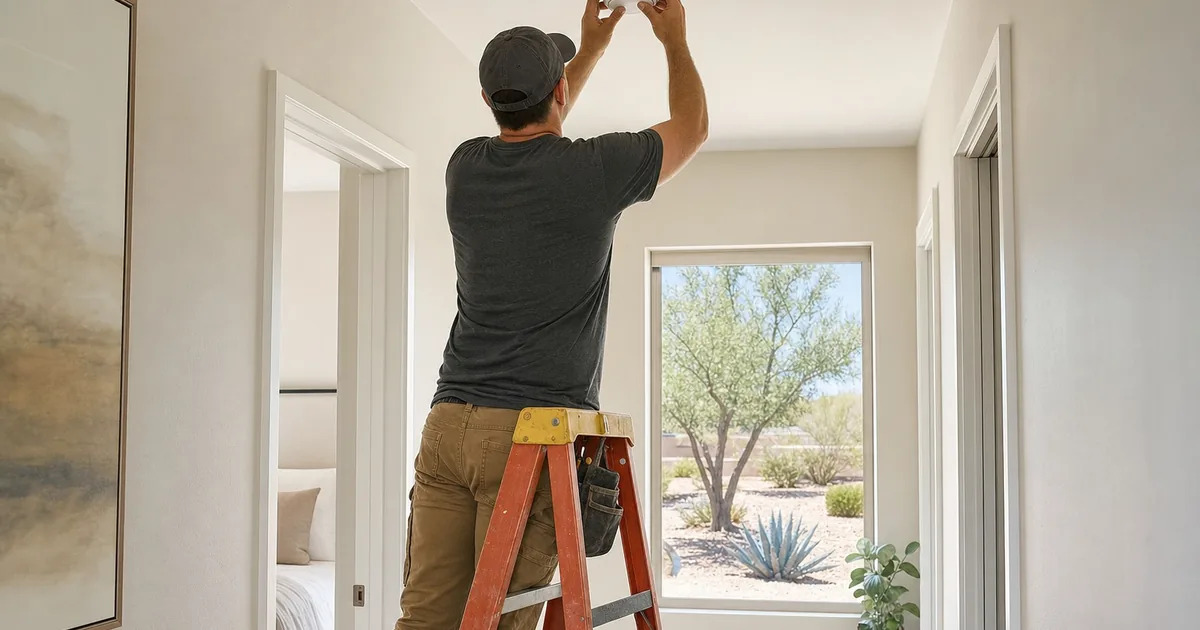
Smoke detector installation in Chandler, AZ covers two different kinds of work: battery alarms that almost anyone can mount, and hardwired smoke detectors that are connected to the house wiring and usually to each other. This guide explains which kind your home has, what the Chandler Fire Department's volunteer program will and will not do, when a City of Chandler permit makes smoke and carbon monoxide alarms mandatory, and how a licensed electrician replaces or adds hardwired, interconnected alarms.
It is written for owners and renters of single-family homes inside Chandler city limits. Each rule below is attributed to the document it comes from, and national statistics are labeled national.
Key takeaways
- Chandler Fire's volunteer Smoke Alarm Program tests alarms, changes homeowner-supplied batteries and installs homeowner-bought battery alarms, but its volunteers cannot do wiring and will not service or install hardwired alarms.
- Chandler Fire's program page says its volunteers cannot service smoke alarms mounted higher than 10 feet from the floor.
- The City of Chandler's homeowner permit manual requires smoke alarms and carbon monoxide detectors, interconnected throughout the house and tested by the Building Inspector, when permitted interior work other than plumbing or mechanical is done.
- Chandler's amendments to the 2024 International Codes make no change to the residential code's smoke and carbon monoxide alarm sections, so those rules apply in Chandler as written.
- NFPA's national data for 2012 to 2016 show 5.7 deaths per 1,000 reported home fires with a working smoke alarm, compared with 12.3 where there was no alarm or none worked.
- Chandler Fire and the U.S. Fire Administration both advise testing smoke alarms monthly and replacing every smoke alarm every 10 years.
Who installs smoke detectors in Chandler: the fire department or an electrician?
Both do, but for different kinds of alarm. The Chandler Fire Department runs a Smoke Alarm Program that uses trained volunteers, and the City describes its aim as making sure there are working smoke alarms in every Chandler home. According to the program page, volunteers test smoke alarms and change batteries the homeowner provides, install battery-operated smoke alarms the homeowner has bought, and provide free smoke alarms to qualifying individuals or families in need. Appointments are made by calling 480-782-2160; the department's general line is 480-782-2120.
The same page sets firm limits. Volunteers "cannot do wiring or electrical work." If a home has hardwired alarms, they will replace the batteries, but they "will not service or install hardwired alarms." They also cannot service alarms mounted more than 10 feet above the floor, which takes in many alarms on vaulted or high ceilings.
So the split is straightforward:
- Battery alarms at a reachable height: start with the fire department's program, particularly if cost is a barrier. The page offers free alarms to qualifying households but does not define who qualifies, so ask when you call.
- Hardwired or interconnected alarms, alarms above 10 feet, and alarm work required by a City permit: that is wiring work, and it belongs with a licensed electrical contractor.
The program also works beyond appointments. A City news release from March 2024 described a volunteer day, held in April 2024, when Chandler Fire, the Arizona Burn Foundation, the American Red Cross and other area fire departments installed free smoke alarms in neighborhoods near Arizona Avenue and Ray Road.
What is the difference between battery, hardwired and interconnected smoke alarms?
The terms describe how an alarm is powered and whether it talks to the others. Knowing which kind you have tells you who can service it and what replacing it involves.
- Battery-only alarms are self-contained. They work only while a charged battery is in place.
- Hardwired alarms are connected to a household circuit and carry a backup battery so they keep sounding when the power is out. The Consumer Product Safety Commission (CPSC) advises installing battery-operated alarms or alarms with battery backup.
- Interconnected alarms are linked so that, in the U.S. Fire Administration's words, "when one sounds, they all sound." In the hardwired systems we work on, that link runs through the wiring between the alarms.
- Combination alarms detect smoke and carbon monoxide in one unit. The City of Chandler's homeowner permit manual notes that dual CO and smoke alarms are available.
Power is why the type matters. In the National Fire Protection Association's January 2019 report on U.S. home fires from 2012 to 2016, missing or disconnected batteries accounted for 43% of the smoke alarms that failed to operate, and dead or discharged batteries for another 25%. Those are national figures covering alarms of every kind. Our reading is that an alarm running on house power with a battery as backup removes the most common way an alarm fails, provided nobody pulls the backup battery or takes the alarm off its base.
On Chandler alarm calls we often find exactly that: a hardwired unit that chirped in the night, had its battery pulled, and was never put back. Silencing an alarm that way leaves the whole interconnected chain one detector short.
When does the City of Chandler require smoke and carbon monoxide alarms during home work?
Whenever the job is interior work that needs a permit, with named exceptions. The City's Home Owners Building Permit Manual (Rev. 4/09/26) says smoke alarms and carbon monoxide detectors are required when performing interior work that requires a permit, "except work such as plumbing or mechanical (air conditioning)." It continues: "If they are not pre-existing throughout the whole house, they must be added." The alarms must also be interconnected and "must be tested by the Building Inspector."
A second passage makes the location rule explicit. When interior alterations, repairs or additions that need a permit are made, the manual says the home must be provided with smoke alarms located as required for new dwellings, and that sleeping rooms, as well as the area outside of sleeping rooms, are required to have smoke alarms.
In practice a permitted remodel or addition can bring a whole-house alarm job with it. A homeowner who pulls a permit for interior work and has alarms in only a few rooms, or alarms that are not linked, should expect the inspector to look for interconnected smoke and CO alarms throughout the house before the job is signed off. Planning the alarm wiring while ceilings and walls are already open is far easier than adding it after the drywall is finished.
Which code applies, and does Chandler amend it?
Chandler has adopted the 2024 editions of the International Codes with the 2023 National Electrical Code, and the City says all plans submitted for review on or after July 1, 2025, must be designed to comply with those editions. The City's local amendments, adopted by Ordinance No. 5108, change a few electrical items, mostly GFCI exceptions, but make no amendment to the residential code's smoke alarm or carbon monoxide alarm sections. Those requirements apply in Chandler as published.
What does Arizona state law add?
Arizona Revised Statutes section 36-1637 requires an approved smoke detector in each new residential housing unit built in the state. For existing units that do not comply, it requires one if a sleeping area is remodeled and the remodeling needs a permit from the local jurisdiction. Our reading: the City's manual reaches further than the statute, because it applies to any permitted interior work other than plumbing or mechanical, and it covers carbon monoxide alarms as well as smoke alarms.
Permit questions go to Chandler Permits at 480-782-3074, and design questions to the Plan Reviewer of the Day at 480-782-3078. The manual lists a minimum permit fee set by the City. On a rented or leased home, the manual says a licensed contractor must pull the permit.
How much difference does a working smoke alarm make in a home fire?
A large one, on national data. Our research found no Chandler figures on fire deaths or alarm performance, so the numbers below are national and come from the NFPA report Smoke Alarms in U.S. Home Fires (M. Ahrens, January 2019), which covers 2012 to 2016.
| Smoke alarm status | Deaths per 1,000 reported home fires (NFPA) | Times the working-alarm rate (our arithmetic) | Change from the no-working-alarm rate (our arithmetic) |
|---|---|---|---|
| Working smoke alarm | 5.7 | 1.0 (baseline) | About 54% lower (5.7 vs 12.3) |
| No alarm, or alarm did not operate | 12.3 | About 2.2 (12.3 divided by 5.7) | Baseline |
How we got this table. The two death rates come from the NFPA report Smoke Alarms in U.S. Home Fires (M. Ahrens, January 2019, 2012-2016 data), read on November 27, 2026 from a copy hosted by the Maine State Fire Marshal's Office. The ratio and percentage columns are our own arithmetic; our 53.7% reduction rounds to the 54% NFPA itself reports. The data are national; no Chandler figures were found.
The same report found that "almost three out of five" home fire deaths in those years happened in properties with no smoke alarms (40%) or where alarms failed to operate (17%). By our subtraction, the other 43% of deaths fell outside those two groups.
Where should smoke and carbon monoxide alarms go in a Chandler home?
Start with the sleeping areas. The City of Chandler's manual says sleeping rooms, and the area outside them, are required to have smoke alarms when permitted interior work brings a home under the alarm rule. The U.S. Fire Administration gives the same advice for every home: put smoke alarms inside and outside each bedroom and sleeping area, and put alarms on every level of the home.
CPSC's carbon monoxide and fire guidance says to install battery-operated alarms or alarms with battery backup on each level and "outside separate sleeping areas." Our reading is that a home with bedrooms in more than one wing needs a hallway location for each group of bedrooms, not a single alarm in the middle of the house.
Two practical points come up on Chandler jobs. First, alarms on vaulted or high ceilings are often above the 10-foot limit Chandler Fire's volunteers work to, so they need a ladder and a licensed crew. Second, a new location has to be reachable by the wiring that feeds and links the others. When we lay out added alarms, we trace where the existing interconnected chain runs before choosing new spots, so each new alarm joins the chain rather than standing alone.
The sources we read do not give exact distances from kitchens, bathrooms, fans or walls. Those details come from the adopted code and each alarm maker's instructions, and on a permitted job the inspector checks them. People with hearing loss can ask about alarms designed for them; the U.S. Fire Administration notes that such alarms exist.
Do Chandler homes need carbon monoxide detectors?
Chandler requires them whenever permitted interior work is done, and federal safety agencies recommend them for every home. Our research found no Arizona statute that requires CO alarms in existing homes; A.R.S. 36-1637 deals with smoke detectors only. The rule Chandler homeowners actually meet is the City's: the homeowner permit manual names carbon monoxide detectors alongside smoke alarms for permitted interior work, interconnected and tested by the Building Inspector.
The federal agencies are direct about why. CPSC staff wrote in June 2025 that they continue "to advocate that all homes have CO alarms." The Centers for Disease Control and Prevention says that every year hundreds of people in the United States die from accidental, non-fire carbon monoxide exposure, and CPSC puts the national average at about 100 deaths a year from CO poisoning linked to portable generators alone.
Carbon monoxide comes from burning fuel. The City lists Southwest Gas among Chandler's utilities alongside SRP and APS, so gas appliances are part of the picture in homes that use them, and portable generators come out when the power fails. If you are planning backup power, read home generator installation in Chandler before the alarms are laid out.
A combination smoke and CO alarm, which the City's manual notes is available, can cover both requirements at one location. Whether a given model satisfies a permit is the inspector's decision, so confirm before buying a houseful.
How does an electrician replace or add hardwired smoke detectors in Chandler?
The order of work is the same whether one alarm is being swapped or a whole house is being brought up to the City's rule.
- Identify what is there: battery or hardwired, interconnected or not, smoke-only or combination, and the date on each unit.
- Settle the permit question. If the alarms are part of permitted interior work, the City's manual already requires them throughout the house. For a stand-alone replacement, ask Chandler Permits at 480-782-3074 whether your job needs a permit before work starts.
- Turn off the alarm circuit at the panel and confirm it is dead at each location.
- Replace or add units that work with each other, running new cable through the attic or ceiling where a new location is needed.
- Restore power and test each alarm, then test the chain so that one alarm sets off the rest.
- Inspection, if permitted. The manual says the interconnected alarms must be tested by the Building Inspector; inspections are requested on 480-782-3100.
Attic work in a Chandler summer is hard going, so when new cable runs are needed we schedule them for the early part of the day. If the alarm circuit's breaker trips after alarms are added, the cause should be found rather than the breaker simply swapped; see circuit breaker repair in Chandler. If a whole-house project also needs new circuits and the panel has no room, electrical panel upgrade in Chandler explains that separate job.
| Job | Chandler Fire volunteers | Licensed electrician (our reading) | Permit question | Document behind it |
|---|---|---|---|---|
| Test alarms; change batteries the homeowner provides | Yes, by appointment (480-782-2160) | Yes | No source we read ties a permit to this | Chandler Fire Smoke Alarm Program page |
| Install battery alarms the homeowner bought | Yes, up to 10 feet from the floor | Yes | No source we read ties a permit to this | Chandler Fire Smoke Alarm Program page |
| Free smoke alarm for a qualifying household | Yes; eligibility not defined on the page | Not applicable | Not applicable | Chandler Fire Smoke Alarm Program page |
| Replace or service a hardwired alarm | Batteries only; will not service or install hardwired alarms | Yes | Ask Chandler Permits, 480-782-3074 | Chandler Fire page; City Building Safety page |
| Any alarm mounted above 10 feet | No | Yes | Depends on the job; ask Chandler Permits | Chandler Fire Smoke Alarm Program page |
| Interconnected smoke and CO alarms during permitted interior work | No (no wiring or electrical work) | Yes | Required throughout the house; tested by the Building Inspector | City Home Owners Building Permit Manual |
| Smoke detector upkeep in a rental home | Not addressed on the program page | Landlord arranges repair after the tenant's written notice | A licensed contractor pulls any permit on a rented home | A.R.S. 36-1637; City Home Owners Building Permit Manual |
How we got this table. This matrix is our own arrangement of the Chandler Fire Department's Smoke Alarm Program page, the City of Chandler Home Owners Building Permit Manual (Rev. 4/09/26), the City's Building Safety page and A.R.S. 36-1637, read on November 27, 2026. The electrician column is our reading of what wiring work involves; no source lists an electrician's tasks. It is not legal or code advice, and the City's decision governs any permit question.
How often should smoke and CO alarms be tested and replaced?
Monthly testing and ten-year replacement are the points every source agrees on. The Chandler Fire Department's program page says to test smoke alarm batteries at least once a month, replace alkaline batteries at least once a year, and replace all smoke alarms every 10 years. The U.S. Fire Administration says to test the alarm monthly and to replace the entire smoke alarm every 10 years, and CPSC says to test CO and smoke alarms monthly.
Hardwired alarms are on the same schedule. They still have a backup battery to change, and the sources set the 10-year smoke alarm replacement without any exception for hardwired units. The sources we read do not give a replacement interval for carbon monoxide alarms, so check the date and instructions printed on the unit. On interconnected systems, pressing the test button on one alarm should sound them all; if it does not, the link is broken somewhere and needs attention. For persistent nuisance alarms or a dead alarm circuit, see electrical repair in Chandler.
When we replace a set of hardwired alarms, it is common to find units of different ages in one chain, because single alarms were swapped over the years. We read the date on every unit before deciding what stays.
Who is responsible for smoke detectors in a Chandler rental home?
Under Arizona law, the tenant keeps the smoke detector working and the landlord repairs it once told in writing. A.R.S. 36-1637 says detectors shall be maintained and kept operable by the tenant unless the tenant gives written notification to the landlord, and that the landlord is responsible for repair if that notice is given.
The City's homeowner manual adds that on a rented or leased home, a licensed contractor must pull any permit, citing A.R.S. 32-1121A. So when a landlord replaces hardwired alarms under a permit, or a rental comes under the alarm rule during permitted interior work, a licensed contractor handles the permit. Chandler Fire's program page describes its volunteer services in terms of the homeowner, so renters should ask the program at 480-782-2160 whether it can help.
What are the most common mistakes with smoke and CO detectors in Chandler?
- Pulling the battery or the alarm to stop a chirp and never putting it back, which breaks the protection the hardwired system was meant to give.
- Swapping one interconnected alarm without testing the chain. One press of a test button should sound every alarm in the house.
- Assuming a remodel permit covers only the room being worked on. The City's manual says alarms must be added throughout the whole house if they are not already there.
- Leaving out carbon monoxide alarms in a home with gas appliances or a generator; the City requires them with permitted interior work, and CPSC staff advocate them for all homes.
- Keeping smoke alarms past 10 years because they still beep when tested.
- Assuming no permit is needed for hardwired alarm work. Ask Chandler Permits at 480-782-3074 before work starts.
Who does hardwired smoke and CO detector work in Chandler?
Battery alarms at reachable heights can be handled by the homeowner or, by appointment, by Chandler Fire's volunteers. Hardwired and interconnected alarms, alarms above 10 feet, and alarm work required by a City permit need someone who can do electrical work, which the fire department says its volunteers cannot. Chandler's manual says permitted work is done by a licensed contractor unless the owner-applicant performs it personally.
Before hiring, ask for the Arizona license number, who will handle any City permit and inspection, and how the interconnection will be tested at the end. If you want the rest of the home's wiring looked at while the alarms are done, see home electrical inspections in Chandler.
Smoke and carbon monoxide alarm work requested through Your Chandler Electrician is performed by Alvey Electric LLC, Arizona Registrar of Contractors license ROC 364723 (R-11, residential). The work is residential only.
Frequently asked questions
Will the Chandler Fire Department install my smoke detectors?
It will install battery alarms, not hardwired ones. Chandler Fire's volunteer Smoke Alarm Program tests smoke alarms, changes batteries the homeowner provides, installs battery-operated alarms the homeowner has bought, and provides free alarms to qualifying households. Its volunteers cannot do wiring or electrical work, will not service or install hardwired alarms, and cannot service alarms more than 10 feet above the floor. Appointments are made at 480-782-2160.
Do I need an electrician to replace hardwired smoke detectors in Chandler?
Yes, in practice. Hardwired alarms are connected to a household circuit and usually to each other, so replacing them is wiring work, and Chandler Fire's volunteers say they will not service or install hardwired alarms. A licensed electrician turns off the circuit, fits units that work together, and tests the whole interconnected chain afterward. Ask Chandler Permits at 480-782-3074 whether your job needs a permit.
When does the City of Chandler require smoke and carbon monoxide alarms during home work?
When you do interior work that requires a permit, other than plumbing or mechanical work such as air conditioning. The City's Home Owners Building Permit Manual says that if smoke alarms and carbon monoxide detectors are not already throughout the whole house, they must be added, they must be interconnected, and the Building Inspector tests them. Sleeping rooms and the areas outside them need smoke alarms.
How much does smoke detector installation cost in Chandler?
This page does not quote a price because no public source sets one. The cost depends on whether the alarms are battery or hardwired, how many locations are involved, whether new cable has to be run through the attic or ceilings for added alarms, whether combination smoke and CO units are used, how high the ceilings are, and whether the job is part of a City permit, which carries its own minimum fee set by the City. A written estimate after a site visit is the reliable figure.
Does Arizona require carbon monoxide detectors in homes?
Our research found no Arizona statute requiring CO alarms in existing homes; A.R.S. 36-1637 covers smoke detectors only. In Chandler, though, the City's homeowner permit manual requires carbon monoxide detectors along with smoke alarms whenever permitted interior work other than plumbing or mechanical is done. CPSC staff advocate that all homes have CO alarms, and the CDC says hundreds of people in the U.S. die each year from accidental non-fire CO exposure.
Where should smoke alarms go in a Chandler home?
Inside and outside every sleeping area and on every level. The City of Chandler's manual says sleeping rooms and the area outside them must have smoke alarms when permitted work brings a home under the rule, and the U.S. Fire Administration advises alarms inside and outside each bedroom and on every level. CPSC adds alarms with battery backup outside separate sleeping areas. Exact distances come from the adopted code and the alarm maker's instructions.
How often should I replace smoke detectors?
Every 10 years, whether battery or hardwired. Chandler Fire's program page says to test smoke alarm batteries at least once a month, replace alkaline batteries at least once a year, and replace all smoke alarms every 10 years, and the U.S. Fire Administration gives the same monthly test and 10-year replacement advice. For carbon monoxide alarms, the sources we read give no interval, so follow the date and instructions on the unit.
Do I need a permit to replace a hardwired smoke detector in Chandler?
Ask before the work starts. If the alarms are part of permitted interior work, the City's manual already requires interconnected smoke and CO alarms throughout the house, tested by the Building Inspector. For a stand-alone replacement, the answer depends on the job, so call Chandler Permits at 480-782-3074 and ask whether yours needs a permit. On a rented or leased home, a licensed contractor must pull any permit.
Who is responsible for smoke detectors in a Chandler rental home?
Under A.R.S. 36-1637, the tenant keeps the smoke detector maintained and working unless the tenant gives the landlord written notice, and the landlord is responsible for repair once that notice is given. The City of Chandler's homeowner manual says a licensed contractor must pull any permit on a rented or leased home, so permitted alarm work in a rental is handled by a licensed contractor.
SRP or APS - does it matter for smoke detector work?
Not for the alarm work itself. The City of Chandler permit and inspection rules for smoke and CO alarms are the same whichever utility serves your address, and alarm work does not involve the meter. It matters if the project grows into panel or service work, which has its own utility steps, and during an outage, when hardwired alarms rely on their backup batteries. SRP customers can report outages at 602-236-8888, and APS customers at 602-371-3680 or 855-688-2437.
Are combination smoke and CO alarms allowed in Chandler?
The City's homeowner permit manual notes that dual CO and smoke alarms are available, in the same section that requires both kinds of alarm for permitted interior work. A combination unit can cover both at one location, but the alarms still have to be interconnected and tested by the Building Inspector, and whether a particular model satisfies the permit is the inspector's decision. Confirm with Chandler Permits at 480-782-3074 before buying.
Who installs hardwired smoke and CO detectors requested through Your Chandler Electrician?
Smoke and carbon monoxide alarm work requested through Your Chandler Electrician is performed by Alvey Electric LLC, Arizona Registrar of Contractors license ROC 364723 (R-11, residential). That includes replacing hardwired alarms, adding interconnected smoke and CO alarms during permitted work, and alarms above the 10-foot limit Chandler Fire's volunteers work to. The work is residential only.
The short version
Sort the job by how the alarm is powered: battery alarms at a reachable height can go to the homeowner or Chandler Fire's volunteers, while anything hardwired, interconnected, above 10 feet or tied to a permit is electrical work. If you are planning permitted interior work, plan for interconnected smoke and CO alarms throughout the house from the start, because the City's manual says the inspector will test them. Whatever the type, test monthly and retire smoke alarms at 10 years.
This page is general information about residential electrical work in Chandler, Arizona. It is not engineering, legal or code advice for a specific property. Permit rules, utility requirements and adopted codes change; confirm current requirements with the City of Chandler and your electric utility before work begins.
References
- Chandler Fire Department, Smoke Alarm Program (volunteer services, limits, appointment line, testing and replacement advice). https://chandleraz.gov/residents/fire/community-outreach/smoke-alarm-program. Read November 27, 2026.
- City of Chandler news release, Chandler firefighters seek volunteers to install smoke alarms and promote fire prevention (March 15, 2024). https://www.chandleraz.gov/news-center/chandler-firefighters-seek-volunteers-install-smoke-alarms-and-promote-fire-prevention. Read November 27, 2026.
- City of Chandler, Home Owners Building Permit Manual (Rev. 4/09/26) (smoke and CO alarm requirements for permitted interior work; rentals; minimum permit fee). https://www.chandleraz.gov/sites/default/files/departments/development-services/City-of-Chandler-Home-Owners-Building-Permit-Manual.pdf. Read November 27, 2026.
- City of Chandler, Amendments to the 2024 International Codes (Ordinance No. 5108). https://www.chandleraz.gov/sites/default/files/departments/development-services/City-of-Chandler-Amendments-to-the-2024-International-Codes.pdf. Read November 27, 2026.
- City of Chandler Development Services, Building Safety: plan review, permits and inspections (2024 International Codes and 2023 NEC; permit and inspection lines). https://www.chandleraz.gov/government/departments/development-services/building-safety-plan-review-permits-and-inspections. Read November 27, 2026.
- Arizona Revised Statutes 36-1637, Smoke detectors. https://azleg.gov/ars/36/01637.htm. Read November 27, 2026.
- U.S. Fire Administration, Smoke alarms (last reviewed October 13, 2026). https://www.usfa.fema.gov/prevention/home-fires/prepare-for-fire/smoke-alarms/. Read November 27, 2026.
- National Fire Protection Association, Smoke Alarms in U.S. Home Fires, M. Ahrens (January 2019, 2012-2016 data), copy hosted by the Maine State Fire Marshal's Office. https://www1.maine.gov/dps/fmo/sites/maine.gov.dps.fmo/files/inline-files/nfpa_smoke_alarms_in_u.s._home_fires.pdf. Read November 27, 2026.
- U.S. Consumer Product Safety Commission, news release on carbon monoxide poisoning and fire safety tips (December 12, 2025). https://cpsc.gov/Newsroom/News-Releases/2026/As-Winter-Storms-Threaten-Millions-in-the-US-CPSC-Issues-Safety-Tips-to-Help-Families-Prevent-Carbon-Monoxide-Poisoning-and-Fires. Read November 27, 2026.
- U.S. Consumer Product Safety Commission staff, report on the stationary generator CO hazard (June 3, 2025). https://www.cpsc.gov/s3fs-public/Report-on-stationary-gen-CO-hazard-FINAL.pdf?VersionId=.eQVnVwTG6boZF_f451Fd6zki2h2qNTG. Read November 27, 2026.
- Centers for Disease Control and Prevention, Carbon monoxide poisoning (Environmental Public Health Tracking). https://www.cdc.gov/environmental-health-tracking/php/data-research/carbon-monoxide-poisoning.html. Read November 27, 2026.
- City of Chandler Economic Development, Locate here (utilities: SRP, APS, Southwest Gas). https://www.chandleraz.gov/business/economic-development/locate-here. Read November 27, 2026.
- Salt River Project, Outages and storm safety. https://www.srpnet.com/customer-service/safety/outages-storm. Read November 27, 2026.
- APS, Contact us (outage numbers). https://aps.com/en/utility/contact-us. Read November 27, 2026.
Get your alarms checked
Request a written estimate for hardwired or interconnected smoke and CO alarms in your Chandler home.
Related pages
- Electrical repair and troubleshooting in Chandler
- Circuit breaker repair and replacement in Chandler
- Home generator installation in Chandler
- Home electrical inspections in Chandler
- Electrical panel upgrade in Chandler
- SRP and APS in Chandler explained
- Chandler neighborhoods we serve
- Your Chandler Electrician home
About this page
Written by the Your Chandler Electrician editorial team from the sources listed above. Reviewed by Robert "Bob" Lira, licensed Arizona electrical contractor, ROC 338369. Your Chandler Electrician, 2139 N Yucca Ct, Chandler, AZ 85224, phone 480-939-3336, serves homes in the City of Chandler. Electrical work is performed by Alvey Electric LLC, Arizona Registrar of Contractors license ROC 364723 (R-11, residential).
Updated .