Residential electrical service - Chandler, Arizona
Generator Installation Chandler AZ: Standby Units, Transfer Switches, SRP and APS (2026 Guide)
How a home generator is permitted, connected and placed in Chandler, and why the answer starts with whether SRP or APS serves the house.
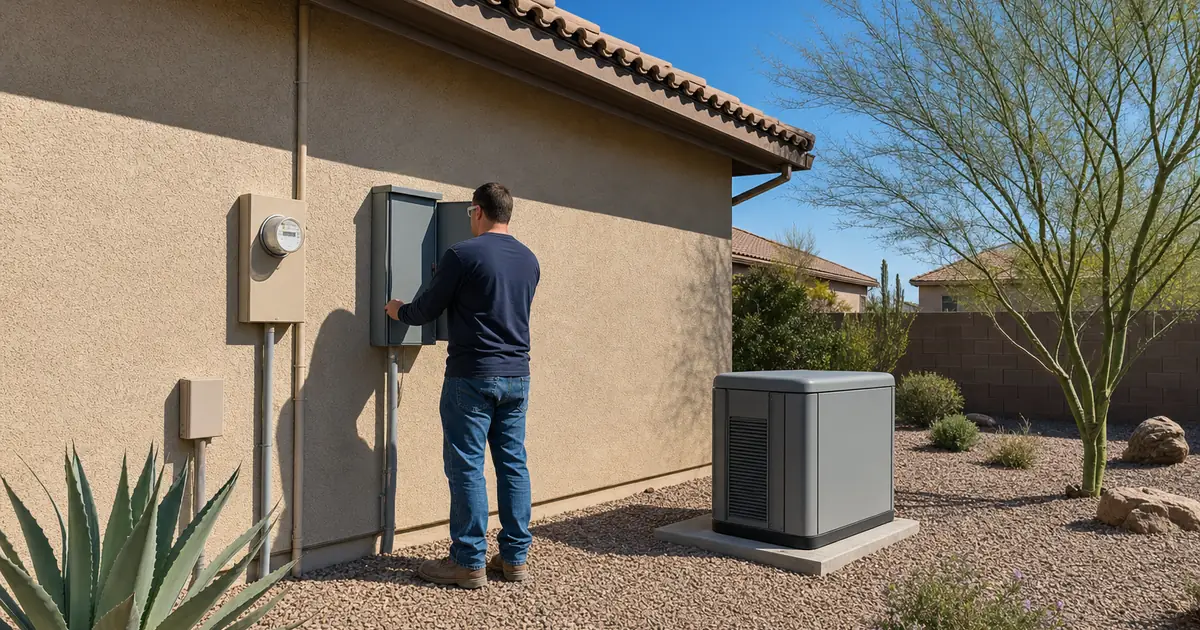
Quick answer
Generator installation in Chandler is permitted electrical work: the City of Chandler issues the permit and inspects to the 2023 National Electrical Code as adopted. The home's utility sets the hookup rules. SRP requires a break-before-make transfer scheme with no interconnection, and APS requires portal approval before energizing and a permanently installed transfer switch for portable units. A natural-gas standby unit adds City gas permit rules and an Arizona 811 call before digging, and CPSC carbon monoxide advice should decide where the unit sits.
Generator installation in Chandler AZ starts with a question most homeowners do not expect: which electric utility serves the house. Chandler has no city electric utility, so every home is connected to SRP or APS, and each utility sets its own rules for how a generator may be tied into a home's wiring. On top of that sits the City of Chandler permit and inspection, and, for a natural-gas standby unit, the City's gas permit rules and a call to Arizona 811 before any trench is dug.
This guide covers portable generators connected through an inlet and transfer equipment, permanently installed standby generators, and what the U.S. Consumer Product Safety Commission (CPSC) has found about carbon monoxide from both. It is written for single-family homes inside Chandler city limits, and it does not quote prices.
Key takeaways
- Wiring a generator into a Chandler home is electrical work, because the City's homeowner manual exempts only the connection of approved portable equipment to approved permanently installed receptacles, so ask Chandler Permits at 480-782-3074 how your job is permitted.
- SRP's electric service specifications require an open-transition, break-before-make transfer scheme for standby generators and say the generation must not be interconnected with the SRP system.
- APS requires on-site generator systems to be submitted and approved through its online portal before they are energized, and allows a portable generator on house wiring only through a permanently installed, approved transfer switch.
- The name on the electric bill, or SRP's address lookup tool, shows whether SRP or APS serves a Chandler home, because no City or utility page we read maps the split by neighborhood.
- The Arizona Corporation Commission says Arizona 811 must be contacted by law before digging, and locators have two full working days to respond to a ticket.
- The CPSC says to run portable generators outside only and at least 20 feet from the house, and CPSC staff have recommended at least 25 feet of separation for stationary units as a staff recommendation, not a code requirement.
What does generator installation in Chandler involve, and which setup fits your home?
Generator installation covers three quite different jobs, and the right one depends on what you need to keep running when the power goes out. The choice decides the equipment, the permit scope, how involved SRP or APS becomes and how much of the yard the project touches.
- Portable generator with an inlet and transfer equipment. The generator stays outdoors and plugs into a weatherproof inlet on the house. A transfer switch, or a breaker interlock on the main panel, lets the homeowner move selected circuits from utility power to generator power without the two ever being connected. It is the smallest wired option, and the generator is started and refueled by hand.
- Permanently installed standby generator. A fixed unit on its own pad, usually fueled by natural gas, wired through a transfer switch that changes over when utility power fails. The City lists Southwest Gas as the gas provider in Chandler, so a gas unit also brings gas piping, gas permit rules and digging.
- Whole house or essential circuits. Either type can be set up to run the whole house or only a chosen group of circuits, such as the refrigerator, some lights, a medical device and the internet equipment. Whole-house coverage needs a larger generator and transfer equipment rated for the whole service.
Every version shares one step: the transfer. A home generator must never feed power back into the utility's lines, and both utilities that serve Chandler say so in their own documents. That single rule is why a generator connected to house wiring is electrical work, not an appliance purchase.
Why do Chandler households add a generator, and what should it keep running?
People who search for a standby generator in Chandler usually have a specific reason: a home medical device that cannot stop, a home office, a freezer full of food, or someone in the household who should not sit through a hot afternoon without cooling. A generator is a decision about priorities, and the priorities decide the size and the type.
No public source we read reports how often or how long power outages last in Chandler, so this page does not claim they are frequent or rare. What can be said is that a summer outage is a different problem from a winter one, because air conditioning is typically one of the largest loads in a home and also the one people most want back. Running central air on generator power takes a much bigger unit than keeping a refrigerator, lights and a few outlets alive.
When we plan a generator with a Chandler homeowner, we start by writing down what must run, what would be nice to run and what can wait for the utility. That list, not the size of the house, is what a load calculation turns into a generator size. It also shows whether a portable unit with an inlet is enough or whether a standby generator is the better fit.
A household that depends on powered medical equipment should also plan with the equipment supplier, and every household should know where it would go if an outage ran long.
Does generator installation in Chandler need a City permit?
Wiring a generator into a home is electrical work, and Chandler handles electrical work through a permit from its Development Services department. The City's Home Owners Building Permit Manual (Rev. 4/09/26) lists work that is exempt from a permit, and the electrical item it describes is the "connection of approved portable electrical equipment to approved permanently installed receptacles", in other words plugging an approved appliance into an existing outlet. The same manual says its exemptions do not cover electric wiring or other work affecting public health or general safety. An inlet, a transfer switch, an interlock and a standby unit all change the home's wiring, so treat them as permit work and ask Chandler Permits at 480-782-3074 how your specific job should be permitted.
The practical details from the City:
- Permit fees are paid through the City's Citizen Access Portal, and inspections are requested on the inspection line at 480-782-3100.
- The permit counter is at 215 E. Buffalo St., open Monday through Friday from 8 a.m. to 5 p.m.; the Plan Reviewer of the Day is at 480-782-3078.
- The manual says permitted work is done by a licensed contractor unless the owner-applicant performs the work personally, and a rented or leased home needs a licensed contractor to pull the permit.
- The manual sets a minimum permit fee and says work done without a permit may be charged double fees.
Chandler has adopted the 2024 International Codes with the 2023 National Electrical Code (Ordinance No. 5108), and the City says plans submitted for review on or after July 1, 2025, must comply with those editions. The adoption includes the International Fuel Gas Code, which matters for a gas-fueled unit. We found no City of Chandler handout on residential generators or transfer switches, and the homeowner manual does not mention generators, so the adopted code applies as written and the inspector's reading governs.
What do SRP and APS require before a generator is connected in Chandler?
Chandler does not run an electric utility. The City lists SRP and APS as the electric providers, and which one serves a home depends on the address. Both utilities protect their lines and crews the same basic way, by keeping a home generator from feeding power back into the grid, but they word and route the requirement differently.
- SRP. SRP's electric service specifications say that for standby generators "an open transition (break-before-make) transfer switching scheme is required," and that the generation must not be interconnected with the SRP electric system. Break-before-make means the house is disconnected from SRP before the generator is connected. SRP also asks that both SRP and the City be contacted before any panel modification or repair, and it reconnects power only when both approve the service entrance work.
- APS. APS's Electric Service Requirements Manual says on-site and temporary generator systems must be submitted and approved through the APS online portal before they are energized. For portable units, APS says they may not be connected to a premises wiring system unless a permanently installed, approved transfer switch isolates the home.
- Both. Meters and meter seals are off limits. SRP prohibits the breaking of seals and tampering with meters by unauthorized persons, and APS allows only its own authorized employees to break seals or move meters. Any generator hookup that involves the meter is not a homeowner project.
Some installers offer a breaker interlock on the main panel instead of a separate transfer switch. Whether a particular device meets SRP's break-before-make requirement or APS's permanently installed, approved transfer switch rule is a question to settle with the inspector and the utility before it is bought. On Chandler generator jobs we read the utility off the electric bill before we choose any transfer equipment, because the approval route depends on it.
| Item | SRP route | APS route | Document behind it |
|---|---|---|---|
| Transfer method | Open-transition (break-before-make) transfer scheme; no interconnection with the SRP system | Portable units only through a permanently installed, approved transfer switch that isolates the home | SRP Electric Service Specifications section 1; APS Electric Service Requirements Manual section 100 |
| Utility review | Contact SRP and the City before any panel modification; SRP reconnects when both approve | Generator system submitted and approved through the APS online portal before energizing | Same two documents |
| Meter and seals | Seal-breaking and meter tampering by unauthorized persons prohibited | Only authorized APS employees may break seals or move meters | Same two documents |
| City of Chandler | Electrical permit and City inspection | Same | City Building Safety page; Home Owners Building Permit Manual |
| Natural-gas standby unit | City gas permit rules; Arizona 811 before digging | Same | Home Owners Building Permit Manual; Arizona Corporation Commission |
| Outage line | (602) 236-8888 | 602-371-3680 or 855-688-2437 | SRP outages page; APS contact page |
| What to do first (our reading) | Confirm the transfer scheme with the inspector before buying equipment | Plan the portal submission so approval comes before the generator is energized | Our reading of the documents above |
How we got this table. This matrix is our own arrangement of SRP's Electric Service Specifications section 1, APS's Electric Service Requirements Manual section 100, the City of Chandler building safety page and homeowner manual, the Arizona Corporation Commission's Arizona 811 page and the two utilities' outage pages, read in November 2026. The last row is our reading, not a utility instruction. No source we read describes which parts of Chandler each utility serves, so the table does not.
How do you find out whether SRP or APS serves your Chandler home?
Look at the name on the electric bill. No City or utility page we read maps which parts of Chandler each utility serves, so we never guess by street or neighborhood. If a bill is not handy, SRP's service-area page has an address lookup tool. For a side-by-side of the two utilities, see SRP and APS in Chandler explained.
What extra steps does a natural-gas standby generator need in Chandler?
A natural-gas standby generator is two projects joined at the pad: the electrical connection and a gas supply line. The City's homeowner manual has a gas permit section with rules that bear directly on a new line to a generator:
- Gas systems are pressure-tested at no less than one and a half times the proposed maximum working pressure.
- Polyethylene (PE) pipe is not allowed beneath any building slab or structure.
- Galvanized fittings or piping are prohibited in underground gas systems.
Digging is the step people skip. The Arizona Corporation Commission says that "by law, you must contact Arizona 811 before" excavating, that the service is free and statewide, and that a request can be made by calling 811 or online through Exactix. Locators have two full working days to respond, and the Commission says to wait until every utility on the ticket has responded. A trench for a gas line or for electrical conduit to a generator pad is excavation.
We found no Southwest Gas page describing how it handles a new generator load at an existing gas meter, so ask the gas utility early whether your meter and service can carry the added load. On gas standby jobs we sequence the trench, the 811 ticket and the inspections together, so nothing is backfilled before the inspector has seen it.
Where should a generator be placed at a Chandler home?
Placement is where generator safety is won or lost, because engine exhaust contains carbon monoxide (CO), a gas you cannot see or smell. The CPSC tells consumers to operate portable generators outside only, at least 20 feet away from the house. Running one in a garage, carport or under a patio roof contradicts that advice.
Permanently installed units are a newer concern. In a June 2025 report, CPSC staff wrote that "for 105 homes, a stationary generator was identified as the source of CO," called the 5-foot enclosure-to-opening clearance allowed in NFPA 37 inadequate, and recommended increasing that separation to at least 25 feet. That is a CPSC staff recommendation, not a code requirement adopted by Chandler. It is still a strong reason to keep a standby unit well away from windows, doors, vents and outdoor living space, and to treat the manufacturer's clearances as a minimum rather than a target.
Chandler's own placement rules are address-specific. The City's planning FAQ says minimum building setbacks vary by zoning district and neighborhood and directs questions to a City Planner at 480-782-3050. We found no Chandler rule written specifically for generator setbacks, screening, noise or running hours, so ask the planner about your lot and check any homeowners association rules before the pad is poured. Measure the distance to every window, door and vent, including those on a neighbor's house, before the location is settled.
How dangerous is carbon monoxide from generators, and what do the numbers show?
The CPSC says an average of about 100 consumers die in the U.S. each year from CO poisoning from portable generators. That is a national figure; we found no Chandler-specific count.
The CPSC's detailed report on engine-driven generators counts 814 generator-associated non-fire CO deaths in 624 incidents from 2011 through 2021, with 581, about 71%, at fixed-structure homes. The chart shows that national count year by year. The CPSC notes that because of reporting delays the figures for 2020 and 2021 should be considered incomplete, so the low 2021 bar is not evidence of a decline.
| Year | Deaths (CPSC) | Share of 2011-2021 total (our arithmetic) |
|---|---|---|
| 2011 | 96 | 11.8% |
| 2012 | 49 | 6.0% |
| 2013 | 59 | 7.2% |
| 2014 | 49 | 6.0% |
| 2015 | 77 | 9.5% |
| 2016 | 75 | 9.2% |
| 2017 | 83 | 10.2% |
| 2018 | 76 | 9.3% |
| 2019 | 95 | 11.7% |
| 2020 (incomplete) | 103 | 12.7% |
| 2021 (incomplete) | 52 | 6.4% |
| Total | 814 | 100% |
How we got this table. Deaths by year and the 814 total come from the CPSC report on fatal incidents associated with non-fire carbon monoxide poisoning from engine-driven generators and other engine-driven tools, 2011-2021, published June 2022 and read November 27, 2026. The share column is our arithmetic: each year divided by 814, rounded to one decimal place. These are national figures, the CPSC says 2020 and 2021 are incomplete, and no Chandler-specific count was found.
CPSC staff continue to advocate that all homes have CO alarms. A generator project is a good time to check yours; see smoke and carbon monoxide detectors in Chandler.
What size generator does a Chandler home need?
The right size comes from a load calculation of what the generator will actually carry, not from the floor area of the house. A contractor lists every load on the chosen circuits, notes the ones that surge at start-up, such as compressors and pumps, and sizes the generator and transfer equipment to match. Whole-house coverage includes the air conditioning; an essential-circuits plan usually leaves it off or limits it.
Three things in the house shape the answer. First, the main service: transfer equipment for whole-house coverage has to be rated for the whole service, and a panel that is full or in poor condition may need work first; see electrical panel upgrade in Chandler. Second, large loads: an EV charger, a pool pump or an electric range can push a whole-house plan to a much larger unit, so decide whether those run on the generator at all; charger loads are covered on EV charger installation in Chandler. Third, how the generator will be run: a portable unit needs someone home to start and refuel it, while a gas standby unit changes over on its own and does not need refueling.
A smaller generator that runs the essentials and sits in the right place is a better result than a larger one placed badly or connected without approved transfer equipment.
What are the steps of a standby generator installation in Chandler?
- Confirm the utility. Read SRP or APS off the electric bill, or use SRP's address lookup.
- Load calculation and plan. Decide whole house or essential circuits, the generator type and the transfer equipment.
- Site the unit. Check setbacks with a City Planner, any homeowners association rules, and the distance to windows, doors and vents.
- Permits. Obtain the City of Chandler electrical permit, and follow the gas permit rules for a gas unit.
- Utility step. On SRP, use a break-before-make transfer scheme and contact SRP and the City before any panel modification; on APS, submit the generator system through the APS online portal for approval before energizing.
- Arizona 811 and trenching. Open a ticket and wait until every utility on it has responded.
- Install and inspect. Set the pad, unit, gas line, conduit and transfer equipment; request the City inspection on 480-782-3100, or by text at 844-281-3520 at least one business day ahead, as the homeowner manual describes.
- Test and hand over. Test the changeover and walk through how to run and maintain the unit.
Connecting transfer equipment means shutting off utility power to the panel, so the house is without electricity for part of the day; plan refrigeration and medical equipment around it. On an APS address, APS asks for three days' advance notice to de-energize a service outside an emergency.
What are the most common mistakes with generator installation in Chandler?
- Backfeeding through a dryer outlet or a cord with two male ends. It energizes house wiring with no transfer equipment, which neither SRP's no-interconnection rule nor APS's transfer switch rule allows.
- Running a portable generator in the garage or under a patio roof. The CPSC says outside only, at least 20 feet from the house.
- Placing a standby unit by looks. Tight against a wall beside a bedroom window is the wrong spot, whatever the minimum clearance says.
- Buying transfer equipment before asking. Confirm with the inspector and SRP or APS first.
- Digging before the Arizona 811 ticket clears. Locators have two full working days, and every utility on the ticket must respond.
- Skipping the permit. The City says unpermitted work may be charged double fees, and an uninspected hookup leaves the transfer step unchecked.
If the power goes out, call your own utility: SRP customers at (602) 236-8888, APS customers at 602-371-3680 or 855-688-2437. Keep away from any fallen power line and call 911; APS says to stay at least 100 feet away and then call APS at 602-258-5483. For a check of the rest of the wiring before a generator goes in, see home electrical inspections in Chandler.
Who is allowed to install a generator in Chandler?
The City's homeowner manual says permitted work is done by a licensed contractor unless the owner-applicant performs it personally, and a rented or leased home needs a licensed contractor to pull the permit. An owner doing the work still needs the permit, the inspection and the utility's transfer rules, and neither SRP nor APS lets unauthorized people break meter seals.
Before hiring, ask for the license number and classification, who takes out the City permit, who handles the SRP or APS step, and who handles the gas piping and the 811 ticket on a gas unit.
Generator installations requested through Your Chandler Electrician are performed by Alvey Electric LLC, Arizona Registrar of Contractors license ROC 364723 (R-11, residential). The work is residential only.
Frequently asked questions
Do I need a permit to install a generator in Chandler?
Ask Chandler Permits at 480-782-3074 before the work starts. The City's homeowner manual exempts only the connection of approved portable equipment to approved permanently installed receptacles, and says its exemptions do not cover electric wiring or other work affecting public health or general safety. An inlet, transfer switch, interlock or standby generator changes the home's wiring, so treat it as permit work, inspected to the 2023 National Electrical Code as adopted by Chandler.
How much does generator installation cost in Chandler?
This page does not quote prices because no public source sets one. The cost depends on whether the job is a portable inlet or a permanent standby unit, whole-house or essential-circuit coverage, the transfer equipment, the length of any gas line and trench, whether the main panel needs work first, and the City permit, which carries a minimum fee set in the City's homeowner manual. A written estimate after a site visit and a load calculation is the reliable number.
SRP or APS: does it matter for a generator installation in Chandler?
Yes. SRP requires an open-transition, break-before-make transfer scheme for standby generators and says the generation must not be interconnected with its system. APS requires generator systems to be submitted and approved through its online portal before energizing, and allows a portable generator on house wiring only through a permanently installed, approved transfer switch. Check the name on your electric bill or use SRP's address lookup to know which rules apply.
Can I plug a portable generator into a dryer outlet to power my house?
No. Feeding house wiring through an outlet, often called backfeeding, leaves nothing to separate the home from the utility's lines. APS says portable generators may not be connected to premises wiring without a permanently installed, approved transfer switch, and SRP says generation must not be interconnected with its system. Run extension cords to individual appliances instead, or have an inlet and transfer equipment installed under a City permit.
What is the difference between a transfer switch and a generator interlock?
A transfer switch is a separate device that moves selected circuits, or the whole house, from utility power to generator power so the two are never connected. An interlock is a mechanical device on the main panel that stops the main breaker and a generator breaker from being on at the same time. Whether a particular device meets SRP's break-before-make requirement or APS's approved transfer switch rule should be confirmed with the inspector and the utility before buying.
Where should a generator be placed at a Chandler home?
The CPSC says to operate portable generators outside only, at least 20 feet away from the house. For permanently installed units, CPSC staff called the 5-foot clearance to openings allowed in NFPA 37 inadequate and recommended at least 25 feet; that is a staff recommendation, not a Chandler code requirement. Chandler's setbacks vary by zoning district and neighborhood, so ask a City Planner at 480-782-3050 about your lot.
Do I need to call 811 before installing a standby generator?
If the job involves digging, yes. The Arizona Corporation Commission says that by law you must contact Arizona 811 before excavating, by calling 811 or using Exactix online, and that the service is free and statewide. Locators have two full working days to respond, and you should wait until every utility on the ticket has responded. A trench for a gas line or electrical conduit to a generator pad counts as excavation.
What gas rules apply to a natural-gas generator in Chandler?
The City's homeowner manual sets gas permit rules that apply to a new supply line: systems are tested at no less than one and a half times the proposed maximum working pressure, polyethylene pipe is not allowed beneath any slab or structure, and galvanized fittings or piping are prohibited underground. The City lists Southwest Gas as Chandler's gas provider, so ask it early whether your meter and service can carry the added load.
What size generator does a Chandler home need?
It depends on what you want to run. A load calculation lists every load on the chosen circuits, including motors that surge at start-up, and sizes the generator and transfer equipment to match. Keeping a refrigerator, lights, internet equipment and a medical device running takes far less than running central air conditioning, so decide between whole-house and essential-circuit coverage before comparing generators.
Who do I call during a power outage in Chandler?
Call the utility that serves your home: SRP at (602) 236-8888, or APS at 602-371-3680 or 855-688-2437. Keep away from any fallen power line and call 911; APS says to stay at least 100 feet away and then call APS at 602-258-5483. If you run a portable generator during the outage, keep it outside and at least 20 feet from the house, as the CPSC advises.
Can I install a standby generator myself in Chandler?
The City's homeowner manual says permitted work is done by a licensed contractor unless the owner-applicant performs the work personally, and a rented or leased home needs a licensed contractor to pull the permit. An owner still needs the permit, the inspection, the utility's transfer rules, the gas permit rules for a gas unit and an Arizona 811 ticket before digging, and neither SRP nor APS lets unauthorized people break meter seals.
Who performs generator installations requested through Your Chandler Electrician?
Generator installations requested through Your Chandler Electrician are performed by Alvey Electric LLC, Arizona Registrar of Contractors license ROC 364723 (R-11, residential), a residential electrical contractor. The work is residential only. At the estimate stage, ask who will take out the City permit, who handles the SRP or APS step, and who handles the gas piping and the Arizona 811 ticket on a gas-fueled unit.
The short version
Treat a generator as a connection project rather than a purchase: settle whether SRP or APS serves the house first, then choose transfer equipment that the utility and the City inspector will accept. Size it from a written list of what must run, and place it by its distance from windows, doors and vents rather than by looks. Any step that touches the meter, the main panel or the ground under the yard belongs under a City permit with a licensed contractor.
This page is general information about residential electrical work in Chandler, Arizona. It is not engineering, legal or code advice for a specific property. Permit rules, utility requirements and adopted codes change; confirm current requirements with the City of Chandler and your electric utility before work begins.
References
- City of Chandler Development Services, Building Safety: plan review, permits and inspections (2024 International Codes and 2023 NEC for plans submitted on or after July 1, 2025; Citizen Access Portal; inspection line; office hours) https://www.chandleraz.gov/government/departments/development-services/building-safety-plan-review-permits-and-inspections. Read November 27, 2026.
- City of Chandler, Amendments to the 2024 International Codes (Ordinance No. 5108) https://www.chandleraz.gov/sites/default/files/departments/development-services/City-of-Chandler-Amendments-to-the-2024-International-Codes.pdf. Read November 27, 2026.
- City of Chandler, Home Owners Building Permit Manual (Rev. 4/09/26): work exempt from permit, gas permits, minimum fee, inspections by text https://www.chandleraz.gov/sites/default/files/departments/development-services/City-of-Chandler-Home-Owners-Building-Permit-Manual.pdf. Read November 27, 2026.
- City of Chandler Planning and Zoning, FAQs (setbacks vary by zoning district and neighborhood; City Planner 480-782-3050) https://www.chandleraz.gov/index.php/government/departments/development-services/planning-and-zoning/faqs. Read November 27, 2026.
- City of Chandler Economic Development, Locate here (utilities: SRP, APS, Southwest Gas) https://www.chandleraz.gov/business/economic-development/locate-here. Read November 27, 2026.
- Salt River Project, Electric Service Specifications, section 1 general (standby generators, panel modifications, seals, reconnection) https://SRPnet.com/assets/srpnet/pdf/doing-business/builders-developers-contractors/commercial-specifications-guidelines-and-handbooks/ESS-section-1-general.pdf. Read November 27, 2026.
- Salt River Project, Service area and territory (address lookup) https://www.srpnet.com/about/service-area-territory. Read November 27, 2026.
- Salt River Project, Outages and storm safety https://www.srpnet.com/customer-service/safety/outages-storm. Read November 27, 2026.
- APS, Electric Service Requirements Manual, section 100 (generator approval, transfer switches, seals, notice to de-energize) https://www.aps.com/-/media/APS/APSCOM-PDFs/About/Construction-and-Power-Line-Siting/Construction-Services/Electric-Service-Requirements-Manual/100.pdf. Read November 27, 2026.
- APS, Contact us (outage and downed line numbers) https://aps.com/en/utility/contact-us. Read November 27, 2026.
- Arizona Corporation Commission, Call before you dig (AZ 811) https://azcc.gov/customer-assistance/call-before-you-dig-(az-811). Read November 27, 2026.
- U.S. Consumer Product Safety Commission, news release with carbon monoxide and generator safety tips (December 12, 2025) https://cpsc.gov/Newsroom/News-Releases/2026/As-Winter-Storms-Threaten-Millions-in-the-US-CPSC-Issues-Safety-Tips-to-Help-Families-Prevent-Carbon-Monoxide-Poisoning-and-Fires. Read November 27, 2026.
- U.S. Consumer Product Safety Commission, Fatal incidents associated with non-fire carbon monoxide poisoning from engine-driven generators and other engine-driven tools, 2011-2021 (June 2022) https://www.cpsc.gov/s3fs-public/Fatal-Incidents-Associated-with-Non-Fire-Carbon-Monoxide-Poisioning-from-Engine-Driven-Generators-and-Other-Engine-Driven-Tools-2011-2021.pdf. Read November 27, 2026.
- U.S. Consumer Product Safety Commission staff, Report on the stationary generator carbon monoxide hazard (June 3, 2025) https://www.cpsc.gov/s3fs-public/Report-on-stationary-gen-CO-hazard-FINAL.pdf?VersionId=.eQVnVwTG6boZF_f451Fd6zki2h2qNTG. Read November 27, 2026.
Plan your generator hookup
Request a load calculation and a written estimate for a generator at your Chandler home.
Related pages
- Electrical panel upgrade in Chandler
- SRP and APS in Chandler explained
- Smoke and carbon monoxide detectors in Chandler
- EV charger installation in Chandler
- Home electrical inspections in Chandler
- Circuit breaker repair and replacement in Chandler
- Chandler neighborhoods we serve
- Your Chandler Electrician home
About this page
Written by the Your Chandler Electrician editorial team from the sources listed above. Reviewed by Robert "Bob" Lira, licensed Arizona electrical contractor, ROC 338369. Your Chandler Electrician, 2139 N Yucca Ct, Chandler, AZ 85224, phone 480-939-3336, serves homes in the City of Chandler. Electrical work is performed by Alvey Electric LLC, Arizona Registrar of Contractors license ROC 364723 (R-11, residential).
Updated .